Sometimes the Intardweb is awesome, sometimes it's clown shoes. One of the times that it's clown shoes is when people start talking about getting out of a particular weapon system because somebody else reported a problem and then some others said they had similar (or sometimes radically different) problems. Here's something that we tend to forget: guns are ALWAYS a law unto themselves. What is needed is a moderately large sample size in order to see any useful data; otherwise, it's just anecdotal comments. Sure, five people saying they bought a particular gun in a particular time frame having similar problems bears watching, but it's not enough to dump everything and go to another platform based on that.
These comments are inspired by the hand wringing and consternation over the Glock and M&P of late. These two platforms especially have a very very large number of guns in duty gun situations, with large metro Police Departments and Sheriff's Offices, as well as high stress users in less well publicized places. They've been tested and proven, in statistically significant numbers, enough to earn the right to be recommended guns. Until HK decides to make a striker fired world beater-and I have a hard time believing they haven't done that yet, it so obvious-the current duty guns are what to look at: Glocks, SnW MnP, Sig Sauer (even if I would rather beat myself in the head with one rather than shoot it) and even a couple Beretta models. The ones that have been tested and chosen for duty use are still the guns to be your life on..adding the HK, because for some reason they don't seem to care a whole lot about getting those contracts, even though they make the most out of the box accurate and durable pistols going overall, even if they are using state of the art of 1981 firing systems.
Here's the thing: those of us who've been shooting the same guns for a long time tend to be somewhat out of touch with what's going on in the firearms market. Once you have the gun and all the support equipment, and maybe one or two spares of the same model (I didn't used to believe in that, but...I currently have three Glock 19's), its rather common to lose sight of what's going on with the rest of the gun buying public. Lots has happened recently: Gun Culture 2.0 has become a major segment of the new gun buying public, there have been two runs in four years on everything with a trigger, and a WHOLE LOT of people that wouldn't "normally" be in the gun owning group are now because they feel a real pressure that their elected officials aren't listening and are thinking about infringing on their right to own, use, and bear arms.
What that does is put a lot of new buyers in the marketplace, and manufacturers are selling everything they put out the door. Something has to give, and often there are changes made to allow increases in production. Whether that's outsourcing to new parts suppliers or changes in QC/QA, those adjustments get made to try to meet demand. Most people shoot maybe a thousand rounds-and probably significantly less- in their lifetime; those that shoot a multiple of that in a year are a very small segment of the market. Even guns that I wouldn't own if you gave them to me will probably stand up to that light firing schedule.
So what we have are guns that are available and durable enough for what they're designed for, even if they'd literally shoot themselves apart if they were taken to a high round count training class. The Intardweb magnifies both successes and failures beyond their actual status frequently. That said, the number of guns being put out are, by a simple function of the number of guns being bought, going to show some problems here and there. No company can make a perfect product every single time; that's just not realistic. As long as that company keeps its failures to a small fraction-the best of them are under 1%, which is pretty amazing all things considered-that's all we the consumers can realistically ask for. Does it suck to have a new gun that doesn't work? Yes, of course it does. But customer service is often stellar in this day and age, and problems get fixed quickly and relatively painlessly.
I heard it put like this recently. Although this is overstating on a rather grand scale, there is a grain of truth to it: "Every gun out there sucks right now." There is no easy to modify, easy to maintain, easy to shoot well, well supported, durable gun that is guaranteed trouble free. So what to do? Choose a gun that is heavily used as a duty gun, well supported with availability of parts and support gear, in a caliber you can get and shoot enough to be proficient, and be done with it. Don't worry about what the buzz is so much as being worried about investing in being a smart shopper. When you're looking for a tool to defend the life of you and yours, that is NOT the time to be an individual.
Showing posts with label training. Show all posts
Showing posts with label training. Show all posts
Sunday, October 27, 2013


Tuesday, March 05, 2013
Getting Better: some tools that helped
I was talking recently with the home p's about shooting, improving, and what's made the most difference in getting to the goals. There have been a few things that changed things for the better for me, and I don't think I'd be as good as I am (and make no mistake, I still suck. A lot) if not for a few different tools. Some just got me out of my own way, some make things easier to do, and some were helpful in changing my way of thinking and practicing. Since I'm in need of something to write about, I decided I'd throw a list out there and maybe it can help one of my two readers.
The first big improvement for me was switching to a 9mm, which cut my ammo costs, which meant that I could shoot more for the same amount of money. .45 has gotten almost obscene in cost, and it's kept me from shooting it much. I considered classifying with it a couple weeks ago, but decided against it because I realized I was unlikely to compete with it anytime soon. If you can afford to shoot the .45, more power to you; I envy you because I just can't swing it. Granted, ya gotta shoot whatever you can get these days, and I'm thankful I didn't get rid of my .40. Luckily, I was pointed to Glocks early on, and I moved to them from a 1911, so I was already familiar with a short stroke trigger. If I was still shooting my old Taurus PT99 (the gun rags said it was a good gun, and I've learned since that gun rags are generally more miss than hit) or the SnW 4006 that I had for a short while (traded it at a profit for my first 1911) moving to a striker fired gun would have been another quantum leap. They're so much easier to shoot that I wonder why DA/SA trigger mechanisms still exist...and that people buy them.
In addition to shooting more, getting duty quality support gear helped me a TON. Quality gear stands up to constant use. Most of my stuff is Safariland, which is engineered, designed and built for duty use. That stuff lasts for YEARS. I just have to fight my lack of ability now, and not my gear being sub-par or failing while I'm using it. The great thing is that good gear pays for itself in a relatively short time, and the difference in price between minimum level gear and top quality stuff isn't that much. There's about a ten dollar difference between the SERPA and the Safariland ALS, and the ALS is a proven performer that will last longer than your shooting career in most cases. But beyond the durability is a general improvement in design and build quality. Your gear will do what it's supposed to do, rather than not quite being right, such as holding your mags at a weird angle or something along those lines. It's a worthwhile investment, but not dirt cheap, so do your due diligence and research and make sure you're buying quality. It's always about best value, not lowest price.
In terms of the improvement of my actual skills, the thing that made the biggest difference was getting a timer. I have a PACT Club Timer, which does quite a bit of stuff and is a very good value. Competition Electronics Pocket Pro II and the CED 7000 from Competitive Edge Dynamics are also timers I've got varying degrees of experience with. I think my favorite is the CE Pocket Pro II, for ease of use and programing, as well as having a very loud, easy to hear buzzer. A close second goes to the Club Timer, which is not quite so flexible, but does a lot for a reasonable price. If you have a smart phone, the Surefire timer app is probably still available. It was supposed to be a short term availability, but was still out there last time I looked. It works pretty well, and for the price of Free.99, ya can't really go wrong. The downsides are that the buzzer isn't anywhere near as loud and sensitivity can be a problem if you're not shooting alone. The timer don't lie, though. When you think something is working, the timer allows you to test it and prove whether it really is or not. Its caused me to refine my technique by things being proven better by the timer.
Electronic ear pro makes training easier, especially if you're getting professional instruction. If you can't swing electronic muffs, which have quite a wide range of prices (and quality, obviously) then there are ear plugs like the Surefire EP7's that I blogged about a while back that allow low intensity sound through while blocking high pressure sounds like gunshots. I prefer the Peltor Comtacs that I've been running for several years for classes and for when it's cold. The EP7's are quite a bit more comfortable when wearing glasses that aren't flush with your temples.
The last major area of improvement I found is also one that saves money: shooting rounds that matter. How? By shooting "standards". Most of these are designed around 50 to 100 rounds, some less, but all are tests of various skills. The beauty of shooting standards is that you have a quantifiable level to which you can compare your skills. I wish the standards were all published in one place, but there's a pretty good reason why they're not. I sent Mike Pannone a message through the Bookface to inquire if he'd ever considered doing a book of standards in the same form factor as his Glock handbook and the M16/M4 Handbook (both of which are very much worth the investment). He said he had considered it, but that it would be put on the net shortly after release which would make publishing it a waste of time and money. As it is, the standards are out there, and you'll just have to seek them out. Start with the 10-8 Standards, the Hackathorn Standards, and Kyle Defoor's 500 Point Aggregate. That's not necessarily his drill, but he was the one who exposed me to it, through YouTube and then through shooting them with Matt E, who was in Defoor's class about a year ago. Wish I'd gone.
I want to also mention shooting competitively as a method to improvement. There are a couple reasons to shoot competition: first, it gives you a gauge to see where you stand against other competitors, and secondly it puts a little stress on the shooter that is hard to replicate on the range alone. It can also put you in touch with other shooters, and percentages say that some of them will be able to help you. Percentages also say that you'll want to stay away from some of them, but that number is usually very small. If you've never shot a match, go try it. There are lots of gun games, so it's gonna be hard to find something that doesn't appeal to anybody that really wants to shoot. If you don't care for it, at least you gave it an honest shake. Try another game or don't compete, but by all means, give it a chance.
Those are some of the things that have helped me, and I recommend them to shooters looking to improve. This applies to both new shooters and veterans, but these things made a big difference to me. The only single thing that makes a bigger difference is getting professional training. Get trained!
The first big improvement for me was switching to a 9mm, which cut my ammo costs, which meant that I could shoot more for the same amount of money. .45 has gotten almost obscene in cost, and it's kept me from shooting it much. I considered classifying with it a couple weeks ago, but decided against it because I realized I was unlikely to compete with it anytime soon. If you can afford to shoot the .45, more power to you; I envy you because I just can't swing it. Granted, ya gotta shoot whatever you can get these days, and I'm thankful I didn't get rid of my .40. Luckily, I was pointed to Glocks early on, and I moved to them from a 1911, so I was already familiar with a short stroke trigger. If I was still shooting my old Taurus PT99 (the gun rags said it was a good gun, and I've learned since that gun rags are generally more miss than hit) or the SnW 4006 that I had for a short while (traded it at a profit for my first 1911) moving to a striker fired gun would have been another quantum leap. They're so much easier to shoot that I wonder why DA/SA trigger mechanisms still exist...and that people buy them.
In addition to shooting more, getting duty quality support gear helped me a TON. Quality gear stands up to constant use. Most of my stuff is Safariland, which is engineered, designed and built for duty use. That stuff lasts for YEARS. I just have to fight my lack of ability now, and not my gear being sub-par or failing while I'm using it. The great thing is that good gear pays for itself in a relatively short time, and the difference in price between minimum level gear and top quality stuff isn't that much. There's about a ten dollar difference between the SERPA and the Safariland ALS, and the ALS is a proven performer that will last longer than your shooting career in most cases. But beyond the durability is a general improvement in design and build quality. Your gear will do what it's supposed to do, rather than not quite being right, such as holding your mags at a weird angle or something along those lines. It's a worthwhile investment, but not dirt cheap, so do your due diligence and research and make sure you're buying quality. It's always about best value, not lowest price.
In terms of the improvement of my actual skills, the thing that made the biggest difference was getting a timer. I have a PACT Club Timer, which does quite a bit of stuff and is a very good value. Competition Electronics Pocket Pro II and the CED 7000 from Competitive Edge Dynamics are also timers I've got varying degrees of experience with. I think my favorite is the CE Pocket Pro II, for ease of use and programing, as well as having a very loud, easy to hear buzzer. A close second goes to the Club Timer, which is not quite so flexible, but does a lot for a reasonable price. If you have a smart phone, the Surefire timer app is probably still available. It was supposed to be a short term availability, but was still out there last time I looked. It works pretty well, and for the price of Free.99, ya can't really go wrong. The downsides are that the buzzer isn't anywhere near as loud and sensitivity can be a problem if you're not shooting alone. The timer don't lie, though. When you think something is working, the timer allows you to test it and prove whether it really is or not. Its caused me to refine my technique by things being proven better by the timer.
Electronic ear pro makes training easier, especially if you're getting professional instruction. If you can't swing electronic muffs, which have quite a wide range of prices (and quality, obviously) then there are ear plugs like the Surefire EP7's that I blogged about a while back that allow low intensity sound through while blocking high pressure sounds like gunshots. I prefer the Peltor Comtacs that I've been running for several years for classes and for when it's cold. The EP7's are quite a bit more comfortable when wearing glasses that aren't flush with your temples.
The last major area of improvement I found is also one that saves money: shooting rounds that matter. How? By shooting "standards". Most of these are designed around 50 to 100 rounds, some less, but all are tests of various skills. The beauty of shooting standards is that you have a quantifiable level to which you can compare your skills. I wish the standards were all published in one place, but there's a pretty good reason why they're not. I sent Mike Pannone a message through the Bookface to inquire if he'd ever considered doing a book of standards in the same form factor as his Glock handbook and the M16/M4 Handbook (both of which are very much worth the investment). He said he had considered it, but that it would be put on the net shortly after release which would make publishing it a waste of time and money. As it is, the standards are out there, and you'll just have to seek them out. Start with the 10-8 Standards, the Hackathorn Standards, and Kyle Defoor's 500 Point Aggregate. That's not necessarily his drill, but he was the one who exposed me to it, through YouTube and then through shooting them with Matt E, who was in Defoor's class about a year ago. Wish I'd gone.
I want to also mention shooting competitively as a method to improvement. There are a couple reasons to shoot competition: first, it gives you a gauge to see where you stand against other competitors, and secondly it puts a little stress on the shooter that is hard to replicate on the range alone. It can also put you in touch with other shooters, and percentages say that some of them will be able to help you. Percentages also say that you'll want to stay away from some of them, but that number is usually very small. If you've never shot a match, go try it. There are lots of gun games, so it's gonna be hard to find something that doesn't appeal to anybody that really wants to shoot. If you don't care for it, at least you gave it an honest shake. Try another game or don't compete, but by all means, give it a chance.
Those are some of the things that have helped me, and I recommend them to shooters looking to improve. This applies to both new shooters and veterans, but these things made a big difference to me. The only single thing that makes a bigger difference is getting professional training. Get trained!
Sunday, February 10, 2013
Holster thoughts for Concealed Carry
One of the great things about living in a "shall issue" state is that citizens come to realize that they are responsible for their own safety, and they take steps to do something about it. There are a lot of missteps, of course, but steps are steps and as long as you're trying to learn and grow and keep moving forward, that's all that matters to me. Its not easy to remember, sometimes, that everybody starts at zero, regardless of how much you know now or how good your sources of information are.
I've noticed, though, that a lot of holster customers don't really have the information they think they do when they're looking for a way to carry their chosen weapon. For every upside, there is a downside, and that's doubly true for carrying a pistol because all these different areas work together...or against each other if you're not aware of what's up with the what's up. To that end, I wanted to share some thoughts on holsters and the pluses and minuses of them. Hopefully I'll be able to show that unconventional carry is unconventional for a reason, and it's not always a good one.
So where do you start this journey? With a belt. You must have a belt that's built for supporting a pistol. Lots of people hate wearing belts and want to use a paddle holster instead. Well, guess what: a properly designed paddle holster, that's built not to come out with the gun when you draw it, is meant for use with a belt. A good belt is an investment, because quality lasts. They don't have to cost a ton, but the "you get what you pay for" axiom holds true here, too. There are lots of choices: great leather is available from commercial sources like Galco and Bianchi and custom leather makers like Mernickle Custom Holsters, C. Rusty Sherrick and Haugen Handgun Leather. If you want something dressier than nylon without being leather, there are Biothane belts from Maxpedition, who offer the Liger Belt line, and First Spear. There's lots of good nylon, too, from The Wilderness, Ares Gear and others. No matter what you choose, you have to have a belt that will support a holster and the gun that's in it, so stiffness from edge to edge is critical. Flexibility from end to end will generally make a more comfortable belt, but it HAS to be stiff enough to support your holster. Get a belt specifically designed for the purpose and you'll experience way more comfort and far less fatigue, and fatigue is one of the things that will keep you from carrying all the time. The gun you don't have with you when you need it doesn't help you.
The first general category is what I will call belt scabbards, and those can be inside the waistband (IWB) and outside the waistband (OWB). OWB holsters are generally a lot easier to draw from because there's a bit of stand off from the body, at least in comparison to IWB. IWB are generally a good bit easier to hide but hide the gun a good bit more, which is handy when in places where lots of people tend to be, like a movie theater or at church. There's a ton of different materials available, and all of them work while having different characteristics. Leather and synthetic leather will generally be the most comfortable because they eventually break in and mold themselves to you. My main holster is a synthetic belt slide, a Safariland 529 that I've been using for a couple of years now. Incidentally,

those belt loops are snapped, and they work in the easy-on, easy-off method that most people think a paddle will. There are also all-Kydex holsters from Raven Concealment Systems and everyone that's copying their design and making refinements and changes to it (some good, some bad, depending on how much those makers know about carrying a gun). This is the go-to type of holster that is money in the vast majority of situations.
IWB has the advantage of hiding the gun "deeper", but at the expense of making the draw a little more difficult (or a lot more, depending on whether the designer has drawn guns from IWB concealment before) because the gun's grip is held closer to the body. Still, a well designed IWB is very comfortable and hides the gun exceptionally well. My primary IWB is a Bianchi M135 Allusion Suppression which is a great holster with a terrible name. It's a hybrid in that it's a leather base with a kydex/leather pouch for the pistol. The flange of the holster makes it wrap around the hip and is super comfortable, but is easier to draw from and return the holster to because it doesn't collapse.
 It's also tuckable, which means that you can tuck your shirt in behind the belt loops to cover the gun even more, but I don't want to make the gun that hard to get to; I don't tuck shirts in. In an office situation where you're in a suit and have to take that jacket off from time to time, you may not have a choice. My friend Greg Peters at Peters Custom Holsters makes a great IWB holster from Kydex called the Hold Fast that's great, and there are many, many others.
The above are the common methods because they've been proven to work in the widest arrays of situations. Sometimes situations call for alternatives, but they should be seen as alternatives in special situations, rather than primary modes of carry. Why? Because other modes of carry have significant downsides to them, and one must balance those downsides versus what is to be gained. Often, those other modes aren't necessary and put the gun carrying person at a disadvantage. That doesn't make them wrong; far from it. They may be suboptimal for your requirements, and unnecessarily handicapping you. I'm just gonna point them out and give the upside and downside to them. As always, Your Mileage May Vary (YMMV).
Lately a lot of people I know have been using Appendix Inside the Waistband carry (AIWB), which puts the gun on the front of the body on the strong side (whichever the dominant hand is). The plus side to this is that it puts the gun in position to be drawn quickly with little extra movement, and it hides the gun really well, especially with the very minimalist holsters used in this position. There are a couple downsides, too: you're limited by comfort and practicality on what guns you can carry this way; subcompacts like the Glock 26/27 don't have enough muzzle to them to stay put well (obviously depending on holster design) and large guns like a 5" 1911 (the only 1911's as far as I'm concerned; I'm pretty old school in that regard) can be quite a load in that position. Additionally, forget sitting down like a normal human; you're going to have to recline or get jabbed by the gun's muzzle, or carry a much smaller gun with less barrel. I'm not a fan of carrying the smallest possible gun, but I am a fan of carrying the smallest gun YOU CAN EFFECTIVELY FIGHT WITH. Another downside: its not for plus sized people, so if you're carrying a decent sized flesh doughnut, this method isn't going to work optimally for you.
More or less opposite of AIWB carry is Small of the Back (SOB) carry. Again, the plus side is deep carriage of the gun, but there are two significant downsides: first, having a gun in the small of your back may make sitting down very uncomfortable, so i you spend a lot of time seated, this is probably the worst option for you. The other significant downside is that when you go to draw the gun, an adversary can put you in a hammerlock position with just a little pressure on your drawing elbow.
Shoulder holsters work well for carrying under a jacket, and in crappy winter weather are somewhat easier to get guns out of than a waist holster is. The downside is that if the gun is horizontal, your muzzle is constantly sweeping others, and if its vertical, its more difficult to draw from.
Ankle holsters are often seen as the deepest cover position, and in some cases that's true. It's one of the best options for carrying in a seated position, such as when you're driving. When it's your primary method, though, you're limited to what guns you can carry (obviously, the bigger the gun, the less comfortable it is) and can lead to all the impediments you can think of that come from having weight on one foot and not on the other. They may not be severe, but that doesn't mean there's no penalty. Additionally, if you're walking down the street and need your gun, you have two choices to get to it: first, take a knee. If you're getting shot at, you have to choose drawing and returning fire for as long as it takes you to get that gun from your knee, and then moving to cover. The other choice is to be on one foot for as long as it takes you to get the gun off your ankle. If you're on uneven ground or on the low ground, that can present its own set of problems.
Ankle carry is a decent option if you're driving a lot or spending a lot of time at a desk where having a gun on your waist is not practical. Carrying a gun in the car is a tough situation, because the laws governing that can vary a LOT. In KY, its legal to transport your gun on the passenger seat, while I don't believe that's the case in TN, and I'm sure several other states. What several friends have done is to screw a holster to the underside of their steering column, and putting the gun there while driving. I'm still examining that option, and I like the idea. There are other options, as well. In KY, I can conceal any weapon I can inflict deadly force with, so I have other close combat options that other states don't have, and some states may be excessively restrictive on a gun but may not be on a baton or a knife. Know your local and state laws to see what your options are. While I don't believe in taking a knife to a gun fight, I always have a knife at the gunfight.
This post was intended to get a shooter new to carrying to think about the options they have to do so. It's not the be all, end all, and it certainly isn't the exhaustive list. While nothing is always true all the time, with some training, practice and experience, most will find that strong side carriage on the waist is the best option. Don't try to reinvent the wheel just because you're new to the scene, learn from those who've gone before and save yourself some headaches...sorta like how every dang holster ever designed is made for the Glock first. In Police work, they call that a "clue".
Pictures courtesy of Safariland and Bianchi.
I've noticed, though, that a lot of holster customers don't really have the information they think they do when they're looking for a way to carry their chosen weapon. For every upside, there is a downside, and that's doubly true for carrying a pistol because all these different areas work together...or against each other if you're not aware of what's up with the what's up. To that end, I wanted to share some thoughts on holsters and the pluses and minuses of them. Hopefully I'll be able to show that unconventional carry is unconventional for a reason, and it's not always a good one.
So where do you start this journey? With a belt. You must have a belt that's built for supporting a pistol. Lots of people hate wearing belts and want to use a paddle holster instead. Well, guess what: a properly designed paddle holster, that's built not to come out with the gun when you draw it, is meant for use with a belt. A good belt is an investment, because quality lasts. They don't have to cost a ton, but the "you get what you pay for" axiom holds true here, too. There are lots of choices: great leather is available from commercial sources like Galco and Bianchi and custom leather makers like Mernickle Custom Holsters, C. Rusty Sherrick and Haugen Handgun Leather. If you want something dressier than nylon without being leather, there are Biothane belts from Maxpedition, who offer the Liger Belt line, and First Spear. There's lots of good nylon, too, from The Wilderness, Ares Gear and others. No matter what you choose, you have to have a belt that will support a holster and the gun that's in it, so stiffness from edge to edge is critical. Flexibility from end to end will generally make a more comfortable belt, but it HAS to be stiff enough to support your holster. Get a belt specifically designed for the purpose and you'll experience way more comfort and far less fatigue, and fatigue is one of the things that will keep you from carrying all the time. The gun you don't have with you when you need it doesn't help you.
The first general category is what I will call belt scabbards, and those can be inside the waistband (IWB) and outside the waistband (OWB). OWB holsters are generally a lot easier to draw from because there's a bit of stand off from the body, at least in comparison to IWB. IWB are generally a good bit easier to hide but hide the gun a good bit more, which is handy when in places where lots of people tend to be, like a movie theater or at church. There's a ton of different materials available, and all of them work while having different characteristics. Leather and synthetic leather will generally be the most comfortable because they eventually break in and mold themselves to you. My main holster is a synthetic belt slide, a Safariland 529 that I've been using for a couple of years now. Incidentally,

those belt loops are snapped, and they work in the easy-on, easy-off method that most people think a paddle will. There are also all-Kydex holsters from Raven Concealment Systems and everyone that's copying their design and making refinements and changes to it (some good, some bad, depending on how much those makers know about carrying a gun). This is the go-to type of holster that is money in the vast majority of situations.
IWB has the advantage of hiding the gun "deeper", but at the expense of making the draw a little more difficult (or a lot more, depending on whether the designer has drawn guns from IWB concealment before) because the gun's grip is held closer to the body. Still, a well designed IWB is very comfortable and hides the gun exceptionally well. My primary IWB is a Bianchi M135 Allusion Suppression which is a great holster with a terrible name. It's a hybrid in that it's a leather base with a kydex/leather pouch for the pistol. The flange of the holster makes it wrap around the hip and is super comfortable, but is easier to draw from and return the holster to because it doesn't collapse.

The above are the common methods because they've been proven to work in the widest arrays of situations. Sometimes situations call for alternatives, but they should be seen as alternatives in special situations, rather than primary modes of carry. Why? Because other modes of carry have significant downsides to them, and one must balance those downsides versus what is to be gained. Often, those other modes aren't necessary and put the gun carrying person at a disadvantage. That doesn't make them wrong; far from it. They may be suboptimal for your requirements, and unnecessarily handicapping you. I'm just gonna point them out and give the upside and downside to them. As always, Your Mileage May Vary (YMMV).
Lately a lot of people I know have been using Appendix Inside the Waistband carry (AIWB), which puts the gun on the front of the body on the strong side (whichever the dominant hand is). The plus side to this is that it puts the gun in position to be drawn quickly with little extra movement, and it hides the gun really well, especially with the very minimalist holsters used in this position. There are a couple downsides, too: you're limited by comfort and practicality on what guns you can carry this way; subcompacts like the Glock 26/27 don't have enough muzzle to them to stay put well (obviously depending on holster design) and large guns like a 5" 1911 (the only 1911's as far as I'm concerned; I'm pretty old school in that regard) can be quite a load in that position. Additionally, forget sitting down like a normal human; you're going to have to recline or get jabbed by the gun's muzzle, or carry a much smaller gun with less barrel. I'm not a fan of carrying the smallest possible gun, but I am a fan of carrying the smallest gun YOU CAN EFFECTIVELY FIGHT WITH. Another downside: its not for plus sized people, so if you're carrying a decent sized flesh doughnut, this method isn't going to work optimally for you.
More or less opposite of AIWB carry is Small of the Back (SOB) carry. Again, the plus side is deep carriage of the gun, but there are two significant downsides: first, having a gun in the small of your back may make sitting down very uncomfortable, so i you spend a lot of time seated, this is probably the worst option for you. The other significant downside is that when you go to draw the gun, an adversary can put you in a hammerlock position with just a little pressure on your drawing elbow.
Shoulder holsters work well for carrying under a jacket, and in crappy winter weather are somewhat easier to get guns out of than a waist holster is. The downside is that if the gun is horizontal, your muzzle is constantly sweeping others, and if its vertical, its more difficult to draw from.
Ankle holsters are often seen as the deepest cover position, and in some cases that's true. It's one of the best options for carrying in a seated position, such as when you're driving. When it's your primary method, though, you're limited to what guns you can carry (obviously, the bigger the gun, the less comfortable it is) and can lead to all the impediments you can think of that come from having weight on one foot and not on the other. They may not be severe, but that doesn't mean there's no penalty. Additionally, if you're walking down the street and need your gun, you have two choices to get to it: first, take a knee. If you're getting shot at, you have to choose drawing and returning fire for as long as it takes you to get that gun from your knee, and then moving to cover. The other choice is to be on one foot for as long as it takes you to get the gun off your ankle. If you're on uneven ground or on the low ground, that can present its own set of problems.
Ankle carry is a decent option if you're driving a lot or spending a lot of time at a desk where having a gun on your waist is not practical. Carrying a gun in the car is a tough situation, because the laws governing that can vary a LOT. In KY, its legal to transport your gun on the passenger seat, while I don't believe that's the case in TN, and I'm sure several other states. What several friends have done is to screw a holster to the underside of their steering column, and putting the gun there while driving. I'm still examining that option, and I like the idea. There are other options, as well. In KY, I can conceal any weapon I can inflict deadly force with, so I have other close combat options that other states don't have, and some states may be excessively restrictive on a gun but may not be on a baton or a knife. Know your local and state laws to see what your options are. While I don't believe in taking a knife to a gun fight, I always have a knife at the gunfight.
This post was intended to get a shooter new to carrying to think about the options they have to do so. It's not the be all, end all, and it certainly isn't the exhaustive list. While nothing is always true all the time, with some training, practice and experience, most will find that strong side carriage on the waist is the best option. Don't try to reinvent the wheel just because you're new to the scene, learn from those who've gone before and save yourself some headaches...sorta like how every dang holster ever designed is made for the Glock first. In Police work, they call that a "clue".
Pictures courtesy of Safariland and Bianchi.
Sunday, November 18, 2012
Gun Culture 2.0
There's been a fair amount of electronic ink spilled over what's been termed the Gun Culture 2.0, who are the new-to-the-market shooters, especially the young ones, that are also embracing shooting and firearms. These are the "hipper" customers with tattoos and piercings, with an alternative lifestyle vibe to their lives. These are probably also some of the same folks that are driving the "paint in day glow lime green and call it Zombie" craze, too. Since one person appeared to ask me what I thought about this movement, here's my opinion.
There's a ton of different angles to the gun culture: hunting, competitive shooting in it's eleventy billion different games with every type of firearm, personal defense, "prepping", plinking, zombie hunting, and perhaps many more that I've never even heard of. Somewhere there's a gun game that a handful of people are having the time of their life playing, and other people who think they're nuts for being into it.
The gun culture 2.0 people are often portrayed as those with full sleeves, gauges, and lots of other body mods. Phil Labonte, a three gun competitor (who seems to shoot pretty dang well) has a day job singing in the metalcore band "All That Remains". AAC, one of the best suppressor makers on the planet, was way out in front of this movement, having their welder Rachel (now in the marketing and advertising dept. as I understand it) in many of their ads. Rachel is what most would call extensively tattooed and her look is usually somewhere between a 40-50's speed shop vibe and a pin up girl. I haven't met her yet, but from what I've heard, she's really cool. Hoping to change that sometime soon; if I can get a minute out of the booth at SHOT I'd like to make that happen.
Hey, Haj, quit boring us and get on with your opinion on the matter! OK, I hear ya. I'll get on with it.
First, tattoos have become pretty mainstream. I don't have one yet, but I'm one of the few people I know of late that doesn't. That'll happen when the population you work with is primarily military. I'm down with tats; the reason I don't have one is simply because I haven't found anything I want to keep forever. They're just not that uncommon and counter-culture anymore. I quit making impressions based on tats a LONG time ago. A lot of America has as well.
I haven't exactly been quiet that what's collectively been called "zombie marketing" is a trend that I find incredibly stupid. There is, however, no doubt that it's a big trend and its driving a LOT of purchases. If people wanna buy that stuff, then by all means, have at it. My employer won't be offering it, but that's simply because that's not what we do. That I support people buying what they want to buy should not be confused with thinking its not dumb.
Having more gun owners is generally a good thing. With the explosion of the availability of CCW permits, there are lots of new customers and enthusiasts that weren't part of the market before. People have apparently gotten to the point where they realize that depending on the State to defend them is bad policy, so they're doing a little something about it. And through that, people are finding that guns and shooting are cool, and they like it a lot, so they're shooting recreationally and collecting guns because they like guns. All that is a good thing.
Where things become of concern to me are in a couple areas: first, there's more to having and carrying a gun than just taking the class that goes over the laws involved and passing an accuracy test that's pretty pathetic in most cases. Second, getting into this segment of activity comes with political implications. There are plenty of politicians that got elected because of, or have a passion for, taking guns away from lawful owners.
Being a responsible gun owner, no matter what type of gun you own, requires being proficient in it's use. America has been called a country of riflemen. Trust me, we're not. We're not born with the ability to shoot, regardless of what the stories you hear are. If you don't practice, you will suck. Additionally, you will not become Audie Murphy when the balloon goes up, you will rise only to the level of training that you've mastered. Read that last sentence again. Not the level of your training, the level of training that you've MASTERED.
How does one solve that? It ain't by "having your buddy that's had a gun forever teaching you how to shoot". What I'm talking about is professional training, from quality trainers. How to find them takes some research, but the info is all out there. Here's one quick way to filter: avoid controversy. There's a ton of recently retired dudes who've been fighting for more than a decade that can teach it to you. When you come across something that looks promising, do your due diligence and check it out, and thoroughly. You aren't doing me any good by having a gun and not being trained nor going months between practicing. You're as likely to shoot me as the guy you intend to. Be professional about it; the criminals out there are criminals for a living. You need to be able to beat them, and fighting fair is for fools.
New shooters and gun owners have GOT to get involved politically. Join the NRA, join other groups that fight for our collective Second Amendment rights, and all the others while we're at it. Call your representatives and tell them how you want them to vote. Even if you "know" how they'll vote, reinforce that with a call to their office. They work for us; get them working for us if they're not already. Be the boss. Politics are a numbers game, and we've got to leave no doubt that if they're going to vote against our wishes, they won't stay in office. YOU MUST GET INVOLVED IN DEFENDING YOUR RIGHTS!
I'm all about bringing new blood into the the gun culture, and I don't care what it is you're into; I support you in it, even if it's that retarded green zombie stuff. Additionally, I support and implore you stretching your horizons. If you're a hunter or some kind of rifle competitor, try competitive shooting with a pistol. Try USPSA, IDPA, bullseye, fast draw...whatever floats your boat. How will you know if you're into it unless you try it? The main reason I'm not into SASS cowboy action shooting is that I simply don't have the money to invest in the guns to do it.
There's a ton of different angles to the gun culture: hunting, competitive shooting in it's eleventy billion different games with every type of firearm, personal defense, "prepping", plinking, zombie hunting, and perhaps many more that I've never even heard of. Somewhere there's a gun game that a handful of people are having the time of their life playing, and other people who think they're nuts for being into it.
The gun culture 2.0 people are often portrayed as those with full sleeves, gauges, and lots of other body mods. Phil Labonte, a three gun competitor (who seems to shoot pretty dang well) has a day job singing in the metalcore band "All That Remains". AAC, one of the best suppressor makers on the planet, was way out in front of this movement, having their welder Rachel (now in the marketing and advertising dept. as I understand it) in many of their ads. Rachel is what most would call extensively tattooed and her look is usually somewhere between a 40-50's speed shop vibe and a pin up girl. I haven't met her yet, but from what I've heard, she's really cool. Hoping to change that sometime soon; if I can get a minute out of the booth at SHOT I'd like to make that happen.
Hey, Haj, quit boring us and get on with your opinion on the matter! OK, I hear ya. I'll get on with it.
First, tattoos have become pretty mainstream. I don't have one yet, but I'm one of the few people I know of late that doesn't. That'll happen when the population you work with is primarily military. I'm down with tats; the reason I don't have one is simply because I haven't found anything I want to keep forever. They're just not that uncommon and counter-culture anymore. I quit making impressions based on tats a LONG time ago. A lot of America has as well.
I haven't exactly been quiet that what's collectively been called "zombie marketing" is a trend that I find incredibly stupid. There is, however, no doubt that it's a big trend and its driving a LOT of purchases. If people wanna buy that stuff, then by all means, have at it. My employer won't be offering it, but that's simply because that's not what we do. That I support people buying what they want to buy should not be confused with thinking its not dumb.
Having more gun owners is generally a good thing. With the explosion of the availability of CCW permits, there are lots of new customers and enthusiasts that weren't part of the market before. People have apparently gotten to the point where they realize that depending on the State to defend them is bad policy, so they're doing a little something about it. And through that, people are finding that guns and shooting are cool, and they like it a lot, so they're shooting recreationally and collecting guns because they like guns. All that is a good thing.
Where things become of concern to me are in a couple areas: first, there's more to having and carrying a gun than just taking the class that goes over the laws involved and passing an accuracy test that's pretty pathetic in most cases. Second, getting into this segment of activity comes with political implications. There are plenty of politicians that got elected because of, or have a passion for, taking guns away from lawful owners.
Being a responsible gun owner, no matter what type of gun you own, requires being proficient in it's use. America has been called a country of riflemen. Trust me, we're not. We're not born with the ability to shoot, regardless of what the stories you hear are. If you don't practice, you will suck. Additionally, you will not become Audie Murphy when the balloon goes up, you will rise only to the level of training that you've mastered. Read that last sentence again. Not the level of your training, the level of training that you've MASTERED.
How does one solve that? It ain't by "having your buddy that's had a gun forever teaching you how to shoot". What I'm talking about is professional training, from quality trainers. How to find them takes some research, but the info is all out there. Here's one quick way to filter: avoid controversy. There's a ton of recently retired dudes who've been fighting for more than a decade that can teach it to you. When you come across something that looks promising, do your due diligence and check it out, and thoroughly. You aren't doing me any good by having a gun and not being trained nor going months between practicing. You're as likely to shoot me as the guy you intend to. Be professional about it; the criminals out there are criminals for a living. You need to be able to beat them, and fighting fair is for fools.
New shooters and gun owners have GOT to get involved politically. Join the NRA, join other groups that fight for our collective Second Amendment rights, and all the others while we're at it. Call your representatives and tell them how you want them to vote. Even if you "know" how they'll vote, reinforce that with a call to their office. They work for us; get them working for us if they're not already. Be the boss. Politics are a numbers game, and we've got to leave no doubt that if they're going to vote against our wishes, they won't stay in office. YOU MUST GET INVOLVED IN DEFENDING YOUR RIGHTS!
I'm all about bringing new blood into the the gun culture, and I don't care what it is you're into; I support you in it, even if it's that retarded green zombie stuff. Additionally, I support and implore you stretching your horizons. If you're a hunter or some kind of rifle competitor, try competitive shooting with a pistol. Try USPSA, IDPA, bullseye, fast draw...whatever floats your boat. How will you know if you're into it unless you try it? The main reason I'm not into SASS cowboy action shooting is that I simply don't have the money to invest in the guns to do it.
Saturday, September 29, 2012
Plate Rack Time
I got a little tired of explaining why my 6 plate rack times were so horribly slow in the vid I shot for the X300 comparison (the reason is true, I'm just tired of saying it) so I finally figured out how to get this photo off my phone and post it here. This is one of my better ever plate rack runs, but this happened during the day. Distance was about ten yards, from the draw. I think I was using a Sarfariland 6354-DO with a Glock 17 and X300, but I'm not certain of that; could have been a 5189.
 I've learned some more about that speed to first shot, and posted about it here a while back. One of these days, I'll get a photo of that run again, with a more reasonable first shot time. I should be able to get that time to about 4, maybe 4.2 or so.

Sunday, August 05, 2012
can you start at the beginning of the beep?
I noticed something a couple weeks ago, and it was verified at the last match I shot. I started working on it, and have a long way to go, but I think I'm on to something.
I shoot with a timer to give a stimulus that causes me to draw and shoot. I don't have to use it for that, but since I'm gonna be shooting anyway, I might as well get some time data while I'm at it, right? I like having to respond to something rather than choosing the time of shooting; my suspicion is that this is as close as I'm going to be able to get to what might happen in real life when I'm shooting by myself.
One of the first things to notice is that a timer's beep spans a certain amount of time. I suspect mine's about one second long, but I haven't actually looked into it. So, it's got a start, when the buzzer first sounds, and it's got an end, when the buzzer is finished buzzering, right? What I noticed most shooters doing was starting to move at the end of the buzz/beep/zappy sound/whatever, with only the best of them-the master class and the one or two grand masters we see a few times a year-starting their draw as soon as the buzzer starts to sound. Once I started working on that, I noticed that my best runs (and to be clear, there were only a few of them) trimmed a full half second off my times.
At the match a week ago, the number of people who commented "You were shooting a lot better today" or words to that effect was surprising to me. From my perspective I shot about the same as I typically do, with perhaps a little more accuracy than I have previously. But the only reason I didn't win the match is the same reason I usually don't win the match: I'm too slow in running, and there's nothing I can do about that; I've been slow my entire life. The only thing I was doing differently, though, was that I was trying to concentrate on starting to move at the start of the beep.
Now, I'm a never-was and have never been in a gunfight. However, I have several close friends who have, and I can get their impressions on such topics. Speed is an important component of a fight, even a brawl. The guy who's reacting is behind the curve, right? What can be done about that? Seems to me the only option is to shorten the curve, and that could be all the difference. As they say, "you have the rest of your life to figure it out".
The way I worked on it, and this is "a" way and by no means "the" way, so if you have a suggestion I wanna hear it, was to do some dry runs. First I started imagining the buzzer going off, and starting to get my draw going at the beginning of the sound. I then practiced my draw, again trying to get moving as soon as I heard the buzzer. The way I tested this was trying to note where the gun was when the buzzer ended; when I was working it I had the gun partway into presentation when the buzzer stopped. I tried stopping movement a few times when the buzzer ended to see where I was. That's hard to do, and there's so much lag between hearing, processing, and responding to the stimulus that I didn't really take much note of it, and instead just tried to gauge where I was. I think this is where video would be very handy.
Anyway! after a while, I was noticing that my times were improving, and it wasn't because my movements were faster from the hand to the gun to the draw to the presentation. If anything, I was getting slightly slower because it was very hot and humid at the range. It was because I was initiating the movement to get going faster than I had before, and that was entirely because I wasn't waiting for the buzzer to complete before I started moving. What I'm hoping this will assist in doing is that if I have to use my gun for real, I won't be as far behind the curve. I'm hoping that I'm training my brain to process faster. It's smarter than I am, so I expect it'll make a difference in the long run. I just wish I'd started working on this 25 years ago.
I shoot with a timer to give a stimulus that causes me to draw and shoot. I don't have to use it for that, but since I'm gonna be shooting anyway, I might as well get some time data while I'm at it, right? I like having to respond to something rather than choosing the time of shooting; my suspicion is that this is as close as I'm going to be able to get to what might happen in real life when I'm shooting by myself.
One of the first things to notice is that a timer's beep spans a certain amount of time. I suspect mine's about one second long, but I haven't actually looked into it. So, it's got a start, when the buzzer first sounds, and it's got an end, when the buzzer is finished buzzering, right? What I noticed most shooters doing was starting to move at the end of the buzz/beep/zappy sound/whatever, with only the best of them-the master class and the one or two grand masters we see a few times a year-starting their draw as soon as the buzzer starts to sound. Once I started working on that, I noticed that my best runs (and to be clear, there were only a few of them) trimmed a full half second off my times.
At the match a week ago, the number of people who commented "You were shooting a lot better today" or words to that effect was surprising to me. From my perspective I shot about the same as I typically do, with perhaps a little more accuracy than I have previously. But the only reason I didn't win the match is the same reason I usually don't win the match: I'm too slow in running, and there's nothing I can do about that; I've been slow my entire life. The only thing I was doing differently, though, was that I was trying to concentrate on starting to move at the start of the beep.
Now, I'm a never-was and have never been in a gunfight. However, I have several close friends who have, and I can get their impressions on such topics. Speed is an important component of a fight, even a brawl. The guy who's reacting is behind the curve, right? What can be done about that? Seems to me the only option is to shorten the curve, and that could be all the difference. As they say, "you have the rest of your life to figure it out".
The way I worked on it, and this is "a" way and by no means "the" way, so if you have a suggestion I wanna hear it, was to do some dry runs. First I started imagining the buzzer going off, and starting to get my draw going at the beginning of the sound. I then practiced my draw, again trying to get moving as soon as I heard the buzzer. The way I tested this was trying to note where the gun was when the buzzer ended; when I was working it I had the gun partway into presentation when the buzzer stopped. I tried stopping movement a few times when the buzzer ended to see where I was. That's hard to do, and there's so much lag between hearing, processing, and responding to the stimulus that I didn't really take much note of it, and instead just tried to gauge where I was. I think this is where video would be very handy.
Anyway! after a while, I was noticing that my times were improving, and it wasn't because my movements were faster from the hand to the gun to the draw to the presentation. If anything, I was getting slightly slower because it was very hot and humid at the range. It was because I was initiating the movement to get going faster than I had before, and that was entirely because I wasn't waiting for the buzzer to complete before I started moving. What I'm hoping this will assist in doing is that if I have to use my gun for real, I won't be as far behind the curve. I'm hoping that I'm training my brain to process faster. It's smarter than I am, so I expect it'll make a difference in the long run. I just wish I'd started working on this 25 years ago.
Saturday, November 12, 2011
Missapplication of Principles: Motor Skills and Hick's Law
Some things refuse to go away. The items in the title being used incorrectly to illustrate a point are the ones that are my biggest of pet peeves. It's not that they don't exist or aren't factors, it's that they are misapplied as descriptors and misunderstood. And much of the time, they are used as a basis for advocating one technique over another, giving a false picture.
Most often, the gross vs. fine motor skill argument is used to advocate slide grabbing a pistol rather than using the slide stop. Now, to be clear, I use, and as far back as I can remember, have always used, the slide stop to run the slide. However, I don't care what technique is used as long as one isn't getting chosen over the other on bad information. If you're gonna be a slide grabber, go ahead and be a slide grabber. Just don't tell me it's a "gross motor skill, which you'll revert to under pressure." That simple can't be true.
OK, so what's a gross motor skill? By definition, a gross motor skill is a movement that uses large muscle groups. In terms of using a gun, the easy definition to understand is that gross motor skills are everything that happens above the wrist. A fine motor skill, by contrast, is anything that happens below the wrist. The argument is that the ability to do fine motor skills deteriorates under pressure, and that is, of course, true. But examine that a little more closely, and you'll find that it doesn't hold up to scrutiny. Consider this: if you can't use your thumb to release the slide via the slide stop and must grab the slide over the top to do that job, how can you possibly use that same thumb to release an empty or faulty magazine, or control the trigger with the index finger from that same hand? I'm not saying that slide grabbing is wrong; it's a valid technique and it works. Just don't tell me the reason to choose it over running the slide stop is that I can't use that thumb and index finger. If that were true, nobody would ever be purposefully shot because the hands wouldn't work at all.
Incidentally, the reason I chose to run the slide stop is because I put both techniques on the timer, and running the slide stop is considerably faster. The timer is the way I've proven, or had proven, different ways of doing things with a gun. Except in terms of it's use by politicians, time doesn't lie.
Which leads us to Hick's Law. I won't bother going into the history of it, because the Internet doesn't care about that when they're misusing it anyway. In short form, Hick's Law says that it takes your mind too long to choose between two tactics. Worse with three! Therefore, I will show you one response." In terms of raw choices, that's true. If you give an untrained person choices, they'll struggle and make errors in attempting to complete the task as they try to pick a way to do it. No argument there, but this post is about arguments, so what's my beef with it? That beef is, once again, the Law being misapplied.
Anyone who's been around shooting and training for any period of time has no doubt heard the phrase "another tool for the toolbox". But, just as it is with a mechanic, just having the tool doesn't mean much. In the hands of the professional mechanic, the right tool is the fast way to get a job done, and done correctly. It's really no different at the core of fighting with weapons. The tool doesn't really become a tool until you...pay close attention here, here's the difference maker...until you MASTER it. Obviously having a choice and not knowing exactly how to use it in a pressure situation won't help much. But master that skill, and combine it with other mastered skills, and you have the gunfighter that nobody wants to go against. One last example: consider Anderson Silva, UFC Middleweight Champion for quite some time now. He's got kicking skills from muay Thai and karate, a black belt in Brazilian Jui Jitsu for ground fighting, and has knocked out just about everybody he's faced with precision striking skills. Watch him fight, and you'll see a fighter who mixes techniques as he sees fit, and there's no lag time between them. Why is that? The skills have been MASTERED.
For the Love of Pete, if you're going to make an argument for or against a particular technique, make sure the reasons you use are valid. I'd rather hear somebody say "I prefer to do it that way, I'm more confident and comfortable with it" than to misapply physiological or psychological principles in the process. That crap won't go away once it gets out there.
Most often, the gross vs. fine motor skill argument is used to advocate slide grabbing a pistol rather than using the slide stop. Now, to be clear, I use, and as far back as I can remember, have always used, the slide stop to run the slide. However, I don't care what technique is used as long as one isn't getting chosen over the other on bad information. If you're gonna be a slide grabber, go ahead and be a slide grabber. Just don't tell me it's a "gross motor skill, which you'll revert to under pressure." That simple can't be true.
OK, so what's a gross motor skill? By definition, a gross motor skill is a movement that uses large muscle groups. In terms of using a gun, the easy definition to understand is that gross motor skills are everything that happens above the wrist. A fine motor skill, by contrast, is anything that happens below the wrist. The argument is that the ability to do fine motor skills deteriorates under pressure, and that is, of course, true. But examine that a little more closely, and you'll find that it doesn't hold up to scrutiny. Consider this: if you can't use your thumb to release the slide via the slide stop and must grab the slide over the top to do that job, how can you possibly use that same thumb to release an empty or faulty magazine, or control the trigger with the index finger from that same hand? I'm not saying that slide grabbing is wrong; it's a valid technique and it works. Just don't tell me the reason to choose it over running the slide stop is that I can't use that thumb and index finger. If that were true, nobody would ever be purposefully shot because the hands wouldn't work at all.
Incidentally, the reason I chose to run the slide stop is because I put both techniques on the timer, and running the slide stop is considerably faster. The timer is the way I've proven, or had proven, different ways of doing things with a gun. Except in terms of it's use by politicians, time doesn't lie.
Which leads us to Hick's Law. I won't bother going into the history of it, because the Internet doesn't care about that when they're misusing it anyway. In short form, Hick's Law says that it takes your mind too long to choose between two tactics. Worse with three! Therefore, I will show you one response." In terms of raw choices, that's true. If you give an untrained person choices, they'll struggle and make errors in attempting to complete the task as they try to pick a way to do it. No argument there, but this post is about arguments, so what's my beef with it? That beef is, once again, the Law being misapplied.
Anyone who's been around shooting and training for any period of time has no doubt heard the phrase "another tool for the toolbox". But, just as it is with a mechanic, just having the tool doesn't mean much. In the hands of the professional mechanic, the right tool is the fast way to get a job done, and done correctly. It's really no different at the core of fighting with weapons. The tool doesn't really become a tool until you...pay close attention here, here's the difference maker...until you MASTER it. Obviously having a choice and not knowing exactly how to use it in a pressure situation won't help much. But master that skill, and combine it with other mastered skills, and you have the gunfighter that nobody wants to go against. One last example: consider Anderson Silva, UFC Middleweight Champion for quite some time now. He's got kicking skills from muay Thai and karate, a black belt in Brazilian Jui Jitsu for ground fighting, and has knocked out just about everybody he's faced with precision striking skills. Watch him fight, and you'll see a fighter who mixes techniques as he sees fit, and there's no lag time between them. Why is that? The skills have been MASTERED.
For the Love of Pete, if you're going to make an argument for or against a particular technique, make sure the reasons you use are valid. I'd rather hear somebody say "I prefer to do it that way, I'm more confident and comfortable with it" than to misapply physiological or psychological principles in the process. That crap won't go away once it gets out there.
Tuesday, September 13, 2011
Trying to get organized with practice
My ammo budget is rather limited these days. What am I saying...it's always been limited. I love what I do, but I'm not getting rich doing it. I'll take donations, in case either of my readers were wondering.
Once again, I digress! The point is that with a limited budget, maximizing the value of each round becomes critical to being able to improve. To that end, I've attempted to get more organized with what I'm practicing. This came about because there will hopefully be a Classifier shot at our club again soon, so a couple weeks ago I decided to bring the Classifier COF out to the range to reference and to work on what I didn't do very well on. There are parts of that test that I don't work on much, such as one handed and weak hand shooting. Other parts, like shooting and moving, come easy to me, thanks to about ten years in marching bands. Having that course of fire to base practice on was very useful. The actual Classifier is a 90 round exercise, so it works pretty good as a practice test.
If you've been reading here for a while, you may have noticed that I really like shooting with Matt E. It used to be Matt and Paul J, but Paul punked out and decided to move home, get married to a wonderful lady and go to college instead of staying here and shooting with me and Matt. He may have made the right choice, but the jury is deliberating. ;)
Anyway, Matt and I have, in the recent past, shot some interesting Standards, including the 10-8, Hackathorn, and the Operator Standards. There are others, including Kyle Defoor's, the FBI's, and more. The nice thing about these is that they're not incredible wazoo difficult tests, but in the aggregate, your score will suffer if you have a weakness in any of the tested areas.
Now, hopefully in the near future Chris W and Bo R. will be added to the clan, once they get memberships to the range. Both of these dudes are excellent shooters, and good guys to train with. Along with Casey B, that'll make five of us that shoot together, and points out the need to get organized. What I hope to do at some point is to put together a calendar and have everybody have a particular day to bring whatever COF they want to use, whether it's downloaded from somewhere or made up before hand. So, I've begun the collecting of COF's and compiling them in a binder and separating them by type of firearm (handgun, carbine, or both). I'm hoping this will be an easy resource to maximize limited ammunition.
I'm also pondering getting shirts made and having an informal "team" for the monthly matches. The name's picked out, but I have to check with a buddy of mine that does small run custom printed t-shirts. That part could be fun, and has the potential to get big. Have to see where that goes somewhere down the line.
Once again, I digress! The point is that with a limited budget, maximizing the value of each round becomes critical to being able to improve. To that end, I've attempted to get more organized with what I'm practicing. This came about because there will hopefully be a Classifier shot at our club again soon, so a couple weeks ago I decided to bring the Classifier COF out to the range to reference and to work on what I didn't do very well on. There are parts of that test that I don't work on much, such as one handed and weak hand shooting. Other parts, like shooting and moving, come easy to me, thanks to about ten years in marching bands. Having that course of fire to base practice on was very useful. The actual Classifier is a 90 round exercise, so it works pretty good as a practice test.
If you've been reading here for a while, you may have noticed that I really like shooting with Matt E. It used to be Matt and Paul J, but Paul punked out and decided to move home, get married to a wonderful lady and go to college instead of staying here and shooting with me and Matt. He may have made the right choice, but the jury is deliberating. ;)
Anyway, Matt and I have, in the recent past, shot some interesting Standards, including the 10-8, Hackathorn, and the Operator Standards. There are others, including Kyle Defoor's, the FBI's, and more. The nice thing about these is that they're not incredible wazoo difficult tests, but in the aggregate, your score will suffer if you have a weakness in any of the tested areas.
Now, hopefully in the near future Chris W and Bo R. will be added to the clan, once they get memberships to the range. Both of these dudes are excellent shooters, and good guys to train with. Along with Casey B, that'll make five of us that shoot together, and points out the need to get organized. What I hope to do at some point is to put together a calendar and have everybody have a particular day to bring whatever COF they want to use, whether it's downloaded from somewhere or made up before hand. So, I've begun the collecting of COF's and compiling them in a binder and separating them by type of firearm (handgun, carbine, or both). I'm hoping this will be an easy resource to maximize limited ammunition.
I'm also pondering getting shirts made and having an informal "team" for the monthly matches. The name's picked out, but I have to check with a buddy of mine that does small run custom printed t-shirts. That part could be fun, and has the potential to get big. Have to see where that goes somewhere down the line.
Monday, December 06, 2010
10-8 Pistol Test 1: where your skills at?
Matt E. and I shot this course of fire on Saturday. There's nothing ground breaking or outrageously technical in it, but it's a very good test of skills. I should have known that it couldn't be as easy as it appeared because the 5 second time standard is what Hilton Yam says a good Master class competitive shooter can do. Silly Haji. Most of my times were a bit on the plus side of 7 seconds, this first time through.
Click the JPEG, print it and try it. I think you'll find it a very good test of skills, and if you have holes in your game, it'll show those, too! It did for me.
.
Click the JPEG, print it and try it. I think you'll find it a very good test of skills, and if you have holes in your game, it'll show those, too! It did for me.
.

Wednesday, November 10, 2010
There's trained and untrained...but how do you get there?
Despite being an American male, and contrary to public opinion and Intardweb common knowledge, nobody comes into the world knowing how to run a handgun. Rifles are pretty intuitive, and most people can do acceptably well with them with little training. That's not the case with the handgun. The fact of the matter is that pistols are hard to use really well. If you think of the Grand Master pistol shooters in the world, and how many of them there are as a percentage of the country's population, they are indeed a rare breed. Because most female shooters are saddled with instruction from their Paw Paw/old man/brother/uncle/boyfriend/husband (those are all supposed to be different people, and are except in certain states), they're already fighting an uphill battle, and that there are so many that can shoot so well is a testament to their will to win.
I've seen some really wacky things happen at the range. I've seen some folks trying to teach their pals or wives/girlfriends to shoot and doing them a total disservice in their instruction. The "why" of that is that the gun owner isn't trained, either. They're passing on what they think they know about shooting, but which they picked up from movies and TV. Unfortunately, they're watching The Shield instead of Street Kings, and not being able to tell the difference. Why? Because they have no formal training. Even Larry Freakin' Vickers didn't get to where he is by making it all up on his own. He got training.
Yes, you can attend a LAV (the "A" is, I think, the initial of the Latin root word for "Freakin'") class, but if you don't have some existing shooting skills, a base of knowledge and safe gun handling skills, you'll spend the whole time behind the curve and slowing the rest of the class down, making you That Guy. Even if you're female, you'll still be That Guy. Pat Rogers gives a hat with That Guy on the adjusting tab as a memento to That Guy in his classes. Often, that's a previously trained shooter earning it, which means that there wasn't enough training already. it ends up being a bit of a Catch-22: if you're not already trained, how do you progress in training? How do you get trained enough to get trained more, to get better and do so safely? How can one afford it? I'll explain some of how I got to where I am now (which is nowhere near as far along as I want to be), which will hopefully help and perhaps generate some ideas for both the readers of my blog.
I started off like most people do: I got my first rifle for Christmas when I was 16. I still have that rifle, and I wish I'd kept track of how many rounds it has through it; it's a significant number, as a brick of .22 was only about $10 in those days, and we rarely took less than 500 rounds out, every time. That wasn't shooting, though. That was plinking, and there was scant actual shooting going on. I shudder to think where I'd be if I knew then what I know now...
I owned a fair number of guns-most of them middle quality, none duty quality guns yet-and was OK enough that I shot better than most of my friends, and read a lot more magazines than they did. That made me the defacto expert, sad to say. I did realize that I needed some actual schooling to get better, so I started looking around at where I might get some training. I found that the local Community College had an Administration of Justice department, and that there were firearms classes available through that department, with the only prerequisite being the Introduction to Administration of Justice 110, which turned out to be a very informative, fascinating class. Those classes started with the building blocks of marksmanship: sight alignment, sight picture, trigger press and follow through, with an SnW 686 revolver. All courses of fire, which didn't go further back than 15 yards, were from the low ready, and always double action.
Those classes progressed from Beginning to Intermediate to Advanced, the difference being that the advanced class added some moving targets and moving to targets, as well as such things as 25 yard shooting and using barricades. It was more tactics based than marksmanship based, but those principles of marksmanship were there through all three classes. These were every Friday for three hours, for four months; a full semester length class. The fundamentals and safety rules were pounded into my skull and seared on my soul. Or something like that.
From there, I did some competing and shot with as many people that knew more than I did as I could find. About three years ago, I started shooting regularly with Matt E. and Paul J. Matt is a very well trained shooter (he's at a class right now, as a matter of fact), and Paul is one of the most naturally gifted shooters I've met. He's one of those guys that can do everything wrong, but his trigger control is so good he still gets tiny little groups. That's when I went from shooting to training. Working on specific drills, keeping track of times, trying to make every shot a perfect repetition. Now if only it always was a perfect repetition...
The NSSF recently started a new program aimed specifically at the new gun owner with little to no experience called First Shots. I don't know why it took so long for an organization to develop this idea, but the NSSF has done an excellent job with it. The whole point is to be able to get some classroom and range time under very controlled, supervised conditions. The site can be searched to find a club or range near you that is doing this program.
What do you do if you can't find a club doing that program near you? I've talked to a couple range owners that like the concept but have some differences in how they train new shooters, and don't want to be affiliated with an organization. By all means, contact the local range and inquire. It's possible that they don't know about First Shots, and may very well want to be a part of it.
Gun shops can be hit or miss on this topic. For every shop that has a squared away staff that knows what's going on around them, there are a whole pile of 'em that pass on really bad information. I don't really know how to get to the good ones. One must be discerning. If you hear something weird that doesn't jibe with what you've heard elsewhere, try to verify it. If you can't, file that bit of info away. Eventually patterns will emerge and you'll be able to tell who's straight up and who's full of crap. Remember though, it's in a shop's best interest to steer you right, so once you find a shop that can get you good info from, patronize them. Many times you will find a knowledgeable employee that has the ability to teach, who can get you started in the right direction. Grab your yellow pages and/or Google, and start with Gun Ranges. If that doesn't prove fruitful, try Gun Shops next. Don't leave out Rod and Gun Clubs. If they are to continue to exist, they need new members. They're a good resource for this sort of thing, as are local USPSA or IDPA clubs. The NRA does a lot with training, with a network of certified instructors all over the country. Their programs can be found here.
Expect to travel. Think about it: if you're buying a gun to trust your life to, how much is that life worth? You may have to drive to get to a class, but it's a small price to pay. Consider it an investment, and a savings in ammo not spent reinforcing bad habits and TV technique. Having to drive a couple hours is a small matter in order to get started off right.
If worse comes to worst, consider hosting a class. This is a lot of work and will be much easier when you've got some experience and have networked within the community, because hosting involves contacting the instructor and arranging the times and dates with a local range (can be private property, Police ranges, rod and gun clubs, stuff like that) as well as getting the word out to prospective customers. It's a lot of work, but it's not impossible. The instructors will have a lot of ideas for accomplishing the tasks.
Once you have that base of knowledge, you can move on to the more "high speed" courses, but you have to have decent gun handling skills and some shooting skills to be safe and to not be drinking from the fire hose the whole time you're in the class. I have to tell ya, though: quality training is addicting! Let's face it. Getting better at shooting is just plain fun. Go get some training!
I've seen some really wacky things happen at the range. I've seen some folks trying to teach their pals or wives/girlfriends to shoot and doing them a total disservice in their instruction. The "why" of that is that the gun owner isn't trained, either. They're passing on what they think they know about shooting, but which they picked up from movies and TV. Unfortunately, they're watching The Shield instead of Street Kings, and not being able to tell the difference. Why? Because they have no formal training. Even Larry Freakin' Vickers didn't get to where he is by making it all up on his own. He got training.
Yes, you can attend a LAV (the "A" is, I think, the initial of the Latin root word for "Freakin'") class, but if you don't have some existing shooting skills, a base of knowledge and safe gun handling skills, you'll spend the whole time behind the curve and slowing the rest of the class down, making you That Guy. Even if you're female, you'll still be That Guy. Pat Rogers gives a hat with That Guy on the adjusting tab as a memento to That Guy in his classes. Often, that's a previously trained shooter earning it, which means that there wasn't enough training already. it ends up being a bit of a Catch-22: if you're not already trained, how do you progress in training? How do you get trained enough to get trained more, to get better and do so safely? How can one afford it? I'll explain some of how I got to where I am now (which is nowhere near as far along as I want to be), which will hopefully help and perhaps generate some ideas for both the readers of my blog.
I started off like most people do: I got my first rifle for Christmas when I was 16. I still have that rifle, and I wish I'd kept track of how many rounds it has through it; it's a significant number, as a brick of .22 was only about $10 in those days, and we rarely took less than 500 rounds out, every time. That wasn't shooting, though. That was plinking, and there was scant actual shooting going on. I shudder to think where I'd be if I knew then what I know now...
I owned a fair number of guns-most of them middle quality, none duty quality guns yet-and was OK enough that I shot better than most of my friends, and read a lot more magazines than they did. That made me the defacto expert, sad to say. I did realize that I needed some actual schooling to get better, so I started looking around at where I might get some training. I found that the local Community College had an Administration of Justice department, and that there were firearms classes available through that department, with the only prerequisite being the Introduction to Administration of Justice 110, which turned out to be a very informative, fascinating class. Those classes started with the building blocks of marksmanship: sight alignment, sight picture, trigger press and follow through, with an SnW 686 revolver. All courses of fire, which didn't go further back than 15 yards, were from the low ready, and always double action.
Those classes progressed from Beginning to Intermediate to Advanced, the difference being that the advanced class added some moving targets and moving to targets, as well as such things as 25 yard shooting and using barricades. It was more tactics based than marksmanship based, but those principles of marksmanship were there through all three classes. These were every Friday for three hours, for four months; a full semester length class. The fundamentals and safety rules were pounded into my skull and seared on my soul. Or something like that.
From there, I did some competing and shot with as many people that knew more than I did as I could find. About three years ago, I started shooting regularly with Matt E. and Paul J. Matt is a very well trained shooter (he's at a class right now, as a matter of fact), and Paul is one of the most naturally gifted shooters I've met. He's one of those guys that can do everything wrong, but his trigger control is so good he still gets tiny little groups. That's when I went from shooting to training. Working on specific drills, keeping track of times, trying to make every shot a perfect repetition. Now if only it always was a perfect repetition...
The NSSF recently started a new program aimed specifically at the new gun owner with little to no experience called First Shots. I don't know why it took so long for an organization to develop this idea, but the NSSF has done an excellent job with it. The whole point is to be able to get some classroom and range time under very controlled, supervised conditions. The site can be searched to find a club or range near you that is doing this program.
What do you do if you can't find a club doing that program near you? I've talked to a couple range owners that like the concept but have some differences in how they train new shooters, and don't want to be affiliated with an organization. By all means, contact the local range and inquire. It's possible that they don't know about First Shots, and may very well want to be a part of it.
Gun shops can be hit or miss on this topic. For every shop that has a squared away staff that knows what's going on around them, there are a whole pile of 'em that pass on really bad information. I don't really know how to get to the good ones. One must be discerning. If you hear something weird that doesn't jibe with what you've heard elsewhere, try to verify it. If you can't, file that bit of info away. Eventually patterns will emerge and you'll be able to tell who's straight up and who's full of crap. Remember though, it's in a shop's best interest to steer you right, so once you find a shop that can get you good info from, patronize them. Many times you will find a knowledgeable employee that has the ability to teach, who can get you started in the right direction. Grab your yellow pages and/or Google, and start with Gun Ranges. If that doesn't prove fruitful, try Gun Shops next. Don't leave out Rod and Gun Clubs. If they are to continue to exist, they need new members. They're a good resource for this sort of thing, as are local USPSA or IDPA clubs. The NRA does a lot with training, with a network of certified instructors all over the country. Their programs can be found here.
Expect to travel. Think about it: if you're buying a gun to trust your life to, how much is that life worth? You may have to drive to get to a class, but it's a small price to pay. Consider it an investment, and a savings in ammo not spent reinforcing bad habits and TV technique. Having to drive a couple hours is a small matter in order to get started off right.
If worse comes to worst, consider hosting a class. This is a lot of work and will be much easier when you've got some experience and have networked within the community, because hosting involves contacting the instructor and arranging the times and dates with a local range (can be private property, Police ranges, rod and gun clubs, stuff like that) as well as getting the word out to prospective customers. It's a lot of work, but it's not impossible. The instructors will have a lot of ideas for accomplishing the tasks.
Once you have that base of knowledge, you can move on to the more "high speed" courses, but you have to have decent gun handling skills and some shooting skills to be safe and to not be drinking from the fire hose the whole time you're in the class. I have to tell ya, though: quality training is addicting! Let's face it. Getting better at shooting is just plain fun. Go get some training!
Wednesday, April 21, 2010
Training Courses: thoughts on gear for the new student
In my previous post, I discussed some of my thoughts and some answers to questions that I had as a first time three day carbine class student. Since I didn't touch on what gear I ran and how it worked out much, I figured I'd about double the amount of posts I'm putting up in a typical month and see if I can knock this missive out before I fall asleep and bash my head into my desk. Funny, of course, but I don't like having to explain those black eyes at work. It also damages my Intardweb Celebrity. Can't have that.
To me, gear is something that deserves some thought before a class. Because I believe in train as you fight, getting too much gear can be a hindrance rather than a help to being able to apply what you learn. If you're a SWAT cop or door kickin' Soldier, then it makes a lot of sense to run the course in your duty gear, including armor. That's how you're going to be doing it for real, so the most value will be in training in your gear. If that's not what you do, though, running a lot of gear just to look cool may soon get in the way and stop you from learning. When you figure that going to a class far enough away that you'll have to stay away from home to go is going to cost you a thousand dollars or more, having a breach in learning is a catastrophic failure.
I'm gonna tell you what I ran in the class, and then I'm going to point out a couple issues that had to be worked around or changed. I did find some things that didn't work out as I had planned. That happens when new gear goes to class.
I had to carry four to five magazines per relay, which I did by a chest rig and a first line belt. I gotta shoot some photos, but that may have to wait till after the match this weekend. I also needed two to three pistol magazines. That number is variable because I wasn't using them a lot and I'm not certain I truly needed more than one spare. It was handy to have a pair, and I compete with a double pistol magazine pouch, so I think I'd have preferred that in any case.
My chest rig is the ATS Low Profile Chest Harness, which I carried four magazines and a tourniquet in. The harness holds three magazines in pouches, and has two upright utility pouches hard sewn to it. I used the right hand pouch to hold a Tac Med Tourniquet. The left hand pouch did multiple duty. I typically used it to carry an M4 magazine, but I also used it for my fourth MnP 9 magazine, and also for loose rounds. The thing that's different about my harness is that it was made of 500D (denier) instead of 1000D Cordura. It's about half the weight and about 70% of the strength of the heavier "thousand d" harness. For a training rig, it's just about perfect. I'm fairly sure they'll be available in the near future, but I'm not certain when.
I used an ATS War Belt for my belt kit, and for training, I found a lot to like about this rig. I ran an ATS War Belt Insert Belt, which turned out to be much better than I expected it to be. Its a flexible belt, which usually doesn't bode well for hanging a holster from it. Flexible belts will sag under the weight of the holster. However, since the inside of the War Belt is lined with hard side Velcro and the Insert Belt is soft side Velcro, they pretty much lock together. I also used ATS suspenders on that belt.
On the War Belt, I used a Safariland ALS holster for a S&W M&P9 with an X300 light from Surefire. The holster is attached to a UBL (Universal Belt Loop), which drops it down below the belt 2". The bottom of the War Belt is left open for just this purpose. That way, the hanger runs off the inner belt, rather than taking up valuable PALS webbing on the War Belt's outside. I also used a 500D Roll Up Dump Pouch from ATS behind my left hip, and used a Safariland M77 single M4 magazine pouch. This was used as a "speed pouch", and was typically where I was keeping the mag I used when I needed it fast or where I kept the magazine I loaded out of when doing the five round loads of the Modified Navy Qual. That was attached to the belt with a Safariland MLS hook. I also have the belt loop and ELS mounting systems, but those are for different purposes. Its a very flexible system.
I initially tried running an ATS double magazine pouch on my War Belt, by my Viking Tactics VTAC sling was getting caught on it. Early on, I moved it to the front of the Low Profile Chest Harness (LPCH from now on). That was somewhat less natural for me, since I pistol reload off the left hip, but I didn't find any other issues other than that the sling occasionally had to be moved over to access the mags. I could have hung them on the utility pouch, but since it's much less rigid, I decided that there'd be more trouble trying to get the mags out of a pouch that wasn't against a "solid" surface. The pouch didn't shift or flop on the left most magazine pouch of the LPCH, so that's where I ran it.
I ran a prototype hydration carrier from ATS specifically for ATS chest harnesses. It's not a final version, but that's gonna be a heck of a good seller. It's money and it probably doesn't even know it...but I do.
My carbine has been listed here several times, but I'll get some new pics of it and throw them in the gear photos that I'm gonna take. The only thing that's changed is that I've added XTM panels from Magpul to the rail, but she's so sexy I can't help but post photos of that gun.
I preloaded my 25 Magpul PMags. After talking to some friends that have done lots of training, and to Pat Rogers about this, I've come to believe there are advantages to preloading even more magazines, to the tune of 40-60. Loading 40 will get you about a thousand rounds in magazines. Why that's important is that other students will have done that. They're relaxing, hydrating, and talking to each other. There is much to be learned from other students, and it may or may not have something to do with guns, gear, or training related stuff. If you're jamming mags, you're going to be less able to be a part of that. The advantage of preloading even more is that you can just dump the partial magazines and grab full ones. Less time messing with loading is more time to spend talking to and listening to the instructor and other students. ABL: Always Be Learning.
It was amazingly hot and humid during the three days I took the class initially, so I wore long sleeve shirts. Wicking shirts are something I consider a must-have. Long sleeve wicking shirts would be even better. They do so much to keep you as cool as you can be under those conditions that they're almost life saving equipment. When Joe and I went back on Sunday for the second class, it was a good ten degrees cooler and breezy. The weather was much better, and I ran a short sleeve t-shirt and a lot of Bullfrog waterproof sunscreen. A long sleeve wicking shirt would have been money, and Joe confirmed that...because that's what he had on.
Because of the amount of time spent on the ground, long pants are a must. I used 5.11 tactical pants, because that's what I have. They gave 'em to me; I kinda have to use it when it's free and it works pretty good. I also used knee pads. In my case, they were Alta Superflex buckle knee pads. Joe borrowed my Black Diamond Telekneesis pads, and said they were a life (or knee) saver. Another good one to take a look at are the Hatch X-Factor pads. Elbow pads are not a bad idea. My elbows got some minor dings, and I would have used pads if I'd had them. For that job, I'd go with neoprene pads for their flexibility and comfort. Finally, I ran good ThorLo and Lorpin socks and a pair of The North Face hiking shoes. Ankle support is a good thing on uneven terrain, when shooting and moving and some running is involved.
My go-to-the-range, concealed and open carry belt is the same old black Aker gunbelt I've had since mid-'05. It refuses to die. I carried my Glock 19 to the range in a Peters Custom Holsters "Hold Fast" IWB rig. It's good stuff.
I think that's all of it. I may edit this later if I think of anything else or I get a good question about something I missed. Pics will be coming soon, probably over the weekend. I'm falling over and have to go to bed.
To me, gear is something that deserves some thought before a class. Because I believe in train as you fight, getting too much gear can be a hindrance rather than a help to being able to apply what you learn. If you're a SWAT cop or door kickin' Soldier, then it makes a lot of sense to run the course in your duty gear, including armor. That's how you're going to be doing it for real, so the most value will be in training in your gear. If that's not what you do, though, running a lot of gear just to look cool may soon get in the way and stop you from learning. When you figure that going to a class far enough away that you'll have to stay away from home to go is going to cost you a thousand dollars or more, having a breach in learning is a catastrophic failure.
I'm gonna tell you what I ran in the class, and then I'm going to point out a couple issues that had to be worked around or changed. I did find some things that didn't work out as I had planned. That happens when new gear goes to class.
I had to carry four to five magazines per relay, which I did by a chest rig and a first line belt. I gotta shoot some photos, but that may have to wait till after the match this weekend. I also needed two to three pistol magazines. That number is variable because I wasn't using them a lot and I'm not certain I truly needed more than one spare. It was handy to have a pair, and I compete with a double pistol magazine pouch, so I think I'd have preferred that in any case.
My chest rig is the ATS Low Profile Chest Harness, which I carried four magazines and a tourniquet in. The harness holds three magazines in pouches, and has two upright utility pouches hard sewn to it. I used the right hand pouch to hold a Tac Med Tourniquet. The left hand pouch did multiple duty. I typically used it to carry an M4 magazine, but I also used it for my fourth MnP 9 magazine, and also for loose rounds. The thing that's different about my harness is that it was made of 500D (denier) instead of 1000D Cordura. It's about half the weight and about 70% of the strength of the heavier "thousand d" harness. For a training rig, it's just about perfect. I'm fairly sure they'll be available in the near future, but I'm not certain when.
I used an ATS War Belt for my belt kit, and for training, I found a lot to like about this rig. I ran an ATS War Belt Insert Belt, which turned out to be much better than I expected it to be. Its a flexible belt, which usually doesn't bode well for hanging a holster from it. Flexible belts will sag under the weight of the holster. However, since the inside of the War Belt is lined with hard side Velcro and the Insert Belt is soft side Velcro, they pretty much lock together. I also used ATS suspenders on that belt.
On the War Belt, I used a Safariland ALS holster for a S&W M&P9 with an X300 light from Surefire. The holster is attached to a UBL (Universal Belt Loop), which drops it down below the belt 2". The bottom of the War Belt is left open for just this purpose. That way, the hanger runs off the inner belt, rather than taking up valuable PALS webbing on the War Belt's outside. I also used a 500D Roll Up Dump Pouch from ATS behind my left hip, and used a Safariland M77 single M4 magazine pouch. This was used as a "speed pouch", and was typically where I was keeping the mag I used when I needed it fast or where I kept the magazine I loaded out of when doing the five round loads of the Modified Navy Qual. That was attached to the belt with a Safariland MLS hook. I also have the belt loop and ELS mounting systems, but those are for different purposes. Its a very flexible system.
I initially tried running an ATS double magazine pouch on my War Belt, by my Viking Tactics VTAC sling was getting caught on it. Early on, I moved it to the front of the Low Profile Chest Harness (LPCH from now on). That was somewhat less natural for me, since I pistol reload off the left hip, but I didn't find any other issues other than that the sling occasionally had to be moved over to access the mags. I could have hung them on the utility pouch, but since it's much less rigid, I decided that there'd be more trouble trying to get the mags out of a pouch that wasn't against a "solid" surface. The pouch didn't shift or flop on the left most magazine pouch of the LPCH, so that's where I ran it.
I ran a prototype hydration carrier from ATS specifically for ATS chest harnesses. It's not a final version, but that's gonna be a heck of a good seller. It's money and it probably doesn't even know it...but I do.
My carbine has been listed here several times, but I'll get some new pics of it and throw them in the gear photos that I'm gonna take. The only thing that's changed is that I've added XTM panels from Magpul to the rail, but she's so sexy I can't help but post photos of that gun.
I preloaded my 25 Magpul PMags. After talking to some friends that have done lots of training, and to Pat Rogers about this, I've come to believe there are advantages to preloading even more magazines, to the tune of 40-60. Loading 40 will get you about a thousand rounds in magazines. Why that's important is that other students will have done that. They're relaxing, hydrating, and talking to each other. There is much to be learned from other students, and it may or may not have something to do with guns, gear, or training related stuff. If you're jamming mags, you're going to be less able to be a part of that. The advantage of preloading even more is that you can just dump the partial magazines and grab full ones. Less time messing with loading is more time to spend talking to and listening to the instructor and other students. ABL: Always Be Learning.
It was amazingly hot and humid during the three days I took the class initially, so I wore long sleeve shirts. Wicking shirts are something I consider a must-have. Long sleeve wicking shirts would be even better. They do so much to keep you as cool as you can be under those conditions that they're almost life saving equipment. When Joe and I went back on Sunday for the second class, it was a good ten degrees cooler and breezy. The weather was much better, and I ran a short sleeve t-shirt and a lot of Bullfrog waterproof sunscreen. A long sleeve wicking shirt would have been money, and Joe confirmed that...because that's what he had on.
Because of the amount of time spent on the ground, long pants are a must. I used 5.11 tactical pants, because that's what I have. They gave 'em to me; I kinda have to use it when it's free and it works pretty good. I also used knee pads. In my case, they were Alta Superflex buckle knee pads. Joe borrowed my Black Diamond Telekneesis pads, and said they were a life (or knee) saver. Another good one to take a look at are the Hatch X-Factor pads. Elbow pads are not a bad idea. My elbows got some minor dings, and I would have used pads if I'd had them. For that job, I'd go with neoprene pads for their flexibility and comfort. Finally, I ran good ThorLo and Lorpin socks and a pair of The North Face hiking shoes. Ankle support is a good thing on uneven terrain, when shooting and moving and some running is involved.
My go-to-the-range, concealed and open carry belt is the same old black Aker gunbelt I've had since mid-'05. It refuses to die. I carried my Glock 19 to the range in a Peters Custom Holsters "Hold Fast" IWB rig. It's good stuff.
I think that's all of it. I may edit this later if I think of anything else or I get a good question about something I missed. Pics will be coming soon, probably over the weekend. I'm falling over and have to go to bed.
Saturday, April 17, 2010
Training Courses: thoughts for the new student
I just got back from three days of the Carbine Operator's Course, taught by the legendary Pat Rogers. This particular class took place in Columbia, TN, a short ways south of Nashvegas, TN. I wanted to blog about this class after the first hour, but as time and training went by, I decided I wanted to take a little different look at it, and not just do another AAR; there are already several very good ones from the class. That would mean this post would have to be taken down the hall to the Department of Redundancy Department.
Instead, I'd like to offer my observations as a new student, to the potential new student who's thinking about taking a class for the first time. This was the first gun fighting course I've taken, although I wouldn't call myself untrained in that area. As a frame of reference, here's a snapshot of what I've done so both readers of my blog can determine where I'm coming from: beginning, intermediate and advanced tactical handgun at Grossmont College in San Diego (through the Administration of Justice department), and training with friends who've trained with several known instructors and are instructors themselves. Most of what I've done has been informal, but the quality of instruction was very good, and I practice those manipulation repetitions regularly.
This will consist of determining if the course is appropriate, what to expect, and some thoughts on what to bring. Out of curiosity, I did some searching before the class, and didn't see anything like this done already. I'm sure that means it's probably not needed, but it's my blog and I don't have to pay for the hosting. Up it goes!
There are two things I consider to be very important that I'm sure get the least amount of attention: knowing who the instructor is and the course description. Knowing who the instructor is becomes important not so much as what he'll teach as what level he's teaching to. Larry Vickers has an introductory class that reads like a beginner's course description, but it's really not. He's Larry Freakin' Vickers. His background is pretty well known: a guy that taught tactical shooting to Operators isn't the first guy to go to when you leave the gun store. Some thought MUST go into choosing a progression of instructors. And, once you know who the instructor is, including their background and what they teach, the course description will make a whole lot more sense. When in doubt, contact the instructor. They want you to have a positive learning experience as much as you do.
You've found an instructor that the Intardweb says you need to be training with if you're cool. That may or may not be a good idea, based on the next factor: matching the course of fire to your physical abilities. I'm really not talking about the PT studs as much as those of us who are...less fit, shall we say. Here's why that's important: when the course says "moderate intensity", what that means is you're going to have to be relatively flexible and be able to do some physical things, like going to your knees about a hundred times in a three day course. Honestly, that was a big problem for me. My knees don't like to be knelt on. Couple that with soreness from the course, and I wasn't able to keep up on the Mod Navy Qual on day three. You've got to be honest with yourself and your abilities to get the most out of the course. Some are more ACQ (Arm Chairborne Qualified) friendly than others. Contact the instructor and ask what type of stuff you'll be doing, and be honest with yourself in your evaluation as to whether you can do it or not. It's your money, invest it wisely.
When and where exactly you choose to attend a class will make a difference in your comfort. Be aware of what the weather is doing and dress appropriately. You may need rain gear, you may need warm clothes. If that's something you need, shop early, and determine what your budget is. If you can't afford decent stuff, you may consider training at another time. Going cheap because you won't use it much may not help you if you tear a hole in it early in the training. You're not deploying with it, but you will be using it a lot, Make sure it's not going to fall apart before you're done with it. The same goes for warm weather gear, and one factor is critically important to both: make sure it's breathable. Overheating or being cold and miserable can both lead to dehydration, which will put you down and keep you from learning.
The class I attended ended up being humid and warmer than average for this time of year. I am prone to sunburn, so I used copious amounts of Bullfrog waterproof sunblock and long sleeved shirts. I also used wicking t-shirts underneath, which was tremendously helpful. Even so, I did sit out a relay. I brought three gallons of water and ten bottles of Gatorade. In this humidity (we're in the middle of April right now) that was about half as much as we ended up using. The cooler, though, was money. The one we used was a 40 quart with wheels and a travel handle. Big enough for about a day and a half of hydro, but we consumed a lot more than we planned. The most important thing is to stay hydrated, and having a cooler full of that stuff was worth the hassle of lugging it along.
Consider food, too, both in what to eat and how the cost impacts attending training. There's a balance to reach between getting calories so you have energy and eating too much and wanting a nap after chow. I certainly got hungry, but tried to eat just enough to stop being hungry. I got my Jetboil up and running again, so I took a Mountain House freeze dried entree for lunch. Worked like a champ! Snacking on NutriGrain bars between did the trick.You might consider an MRE a day if you have some you like, but there are some good freeze dried meals out there that'll keep you from having to leave the range. Interaction with your fellow students is tremendously helpful. Stay where they are. Many classes will meet after the class to break bread. I find this time very helpful, and highly recommend spending the time with your fellow students.
I lived an hour and 40 minutes from where the class range was. That's far enough, to me, to make getting a hotel room worth the cost. The less you travel, the more time you have to prepare for the next day's class. I brought 25 mags that I had preloaded. If I'd needed to, I could have jammed mags in the hotel room. I had all the time I wanted to get cleaned up (and taking ridiculously long showers that I don't do at home because I pay for the water), relax, get sleep, go out to eat with classmates by staying 15 or so minutes from the range. That was a big, big help. Plan that carefully when choosing to attend a class in your region. What you make up in saving money may cost you in other areas. Put some thought into this.
What to bring is an interesting question. Let me preface this by saying that the only thing I brought that I didn't use, other than clothes and the portable DVD player, was my big ol' collapsing chair. I could have, I just didn't need the chair because chairs were provided. As I typically do, I packed more clothes than I used, trying to cover contingencies. People who pack better than I do will be able to take a smaller bag, but since I only have one piece of luggage, I tend to fill it.
I also brought my own pillow. It's a Sobokawa buckwheat hull pillow that I've been versions of for a couple decades now...not the same pillow all that time; I've bought new ones since the original. I find that, for me, the secret to getting some sleep away from home comes down to my own pillow, earplugs, and Simply Sleep. Add to that a cranked up A/C to make the room good and cold, and I tend to fall asleep fairly readily.
My friend Matt E. and I traveled together for this class, and on the way back we discussed the many ways to carry the load required for this class. Many of the students in this were full time Tactical Team members. We had guys who did that for their local PD, and contractors as well. Those guys took the class in their work gear: full armor and full load outs. I don't want those guys coming through the door on me. Those guys are Terminators. Train as you fight was applied in spades.
In other classes, though, there are guys that wear a bunch of gear because they see photos of America's warriors doing so. Yeah, it's cool, but ask them if they want to have to carry that load. They'll say lighter is better. Apply that to a class and you may find that running all that cool kit is getting in the way of your learning because you're suffering. We both came to the conclusion that more is definitely not better in this case. I would posit that the way I went is the best path to follow: not only minimal gear, but I also chose the lightest stuff I could get.
Where the load out comes into play in a big way is this: you're going to be putting out all day long. You're going to be working hard. You're going to fire somewhere over a thousand rounds in three days. What you'll find is that you're going to get sore in places you don't expect to. Your hands will get sore and weak, your shoulder and back muscles will get tight, your knees will get beat up (can't recommend knee pads strongly enough) and your lower back will become irritated. Even though the AR carbine has very little recoil, jamming it into your shoulder will make your shoulder sore. Your forearm muscles will get fatigued from pulling on your carbine all day. You're going to get tired even if you are in good shape but don't shoot that much regularly. Minimize how much compounding of that you do.
Another thing to know is how stuff rides before you get there. You need to spend some time adjusting and situating your gear to find conflicts. I did that and still ended up moving my double pistol magazine pouch to the front left of my harness because it was hanging up on my sling. That's another reason less is more: less conflict and fighting your gear, the more you're learning! See how this works now?
The instructors are the real authorities on what is required to get through their class, and they'll have recommendations for you. I would caution you to do your research ahead of time and try to keep your questions to a minimum. They're on the range literally all day, busting their butt training people. Away from that, they're taking care of administrative issues for the class. They have limited time when they're on the road to take care of such things. Don't pester them. Ask pertinent questions, but don't bombard them with every thought that comes to your head. That's one of the ways to get on the NFE (Not F'ing Ever) list.
Other ways include: being That Guy to the point that what you're doing becomes unsafe or irritating to a level the instructor won't put up with. Having poor gun handling skills in a class that requires being good with them is another way. Whining, arguing, and having a closed mind will all get you NFE'd. If you're trying to prove a point of one training style over another, you're wasting your time and theirs. One of my friends went to train with Larry Vickers, one of the premier pistol instructors extant. A guy paid for, paid to travel to, and paid to be there for a pistol class with The Man. He also did EVERYTHING with the Israeli Method he'd been taught previously. Why go to train with LAV if you're going to bring something else into it and not at least try his way? That's stupid, and a waste of money.
There are several forums that a prospective student can check out to read AAR's (After Action Reports) for various classes and instructors. Google can be a big help. Before you do that, though, have an idea of what it is you wish to be trained on, and be honest with yourself when checking the qualifications.
I will be doing a separate post on the gear I used for this class. I'm not sure if both the readers of my blog care, but I'm gonna do it anyway.
Instead, I'd like to offer my observations as a new student, to the potential new student who's thinking about taking a class for the first time. This was the first gun fighting course I've taken, although I wouldn't call myself untrained in that area. As a frame of reference, here's a snapshot of what I've done so both readers of my blog can determine where I'm coming from: beginning, intermediate and advanced tactical handgun at Grossmont College in San Diego (through the Administration of Justice department), and training with friends who've trained with several known instructors and are instructors themselves. Most of what I've done has been informal, but the quality of instruction was very good, and I practice those manipulation repetitions regularly.
This will consist of determining if the course is appropriate, what to expect, and some thoughts on what to bring. Out of curiosity, I did some searching before the class, and didn't see anything like this done already. I'm sure that means it's probably not needed, but it's my blog and I don't have to pay for the hosting. Up it goes!
There are two things I consider to be very important that I'm sure get the least amount of attention: knowing who the instructor is and the course description. Knowing who the instructor is becomes important not so much as what he'll teach as what level he's teaching to. Larry Vickers has an introductory class that reads like a beginner's course description, but it's really not. He's Larry Freakin' Vickers. His background is pretty well known: a guy that taught tactical shooting to Operators isn't the first guy to go to when you leave the gun store. Some thought MUST go into choosing a progression of instructors. And, once you know who the instructor is, including their background and what they teach, the course description will make a whole lot more sense. When in doubt, contact the instructor. They want you to have a positive learning experience as much as you do.
You've found an instructor that the Intardweb says you need to be training with if you're cool. That may or may not be a good idea, based on the next factor: matching the course of fire to your physical abilities. I'm really not talking about the PT studs as much as those of us who are...less fit, shall we say. Here's why that's important: when the course says "moderate intensity", what that means is you're going to have to be relatively flexible and be able to do some physical things, like going to your knees about a hundred times in a three day course. Honestly, that was a big problem for me. My knees don't like to be knelt on. Couple that with soreness from the course, and I wasn't able to keep up on the Mod Navy Qual on day three. You've got to be honest with yourself and your abilities to get the most out of the course. Some are more ACQ (Arm Chairborne Qualified) friendly than others. Contact the instructor and ask what type of stuff you'll be doing, and be honest with yourself in your evaluation as to whether you can do it or not. It's your money, invest it wisely.
When and where exactly you choose to attend a class will make a difference in your comfort. Be aware of what the weather is doing and dress appropriately. You may need rain gear, you may need warm clothes. If that's something you need, shop early, and determine what your budget is. If you can't afford decent stuff, you may consider training at another time. Going cheap because you won't use it much may not help you if you tear a hole in it early in the training. You're not deploying with it, but you will be using it a lot, Make sure it's not going to fall apart before you're done with it. The same goes for warm weather gear, and one factor is critically important to both: make sure it's breathable. Overheating or being cold and miserable can both lead to dehydration, which will put you down and keep you from learning.
The class I attended ended up being humid and warmer than average for this time of year. I am prone to sunburn, so I used copious amounts of Bullfrog waterproof sunblock and long sleeved shirts. I also used wicking t-shirts underneath, which was tremendously helpful. Even so, I did sit out a relay. I brought three gallons of water and ten bottles of Gatorade. In this humidity (we're in the middle of April right now) that was about half as much as we ended up using. The cooler, though, was money. The one we used was a 40 quart with wheels and a travel handle. Big enough for about a day and a half of hydro, but we consumed a lot more than we planned. The most important thing is to stay hydrated, and having a cooler full of that stuff was worth the hassle of lugging it along.
Consider food, too, both in what to eat and how the cost impacts attending training. There's a balance to reach between getting calories so you have energy and eating too much and wanting a nap after chow. I certainly got hungry, but tried to eat just enough to stop being hungry. I got my Jetboil up and running again, so I took a Mountain House freeze dried entree for lunch. Worked like a champ! Snacking on NutriGrain bars between did the trick.You might consider an MRE a day if you have some you like, but there are some good freeze dried meals out there that'll keep you from having to leave the range. Interaction with your fellow students is tremendously helpful. Stay where they are. Many classes will meet after the class to break bread. I find this time very helpful, and highly recommend spending the time with your fellow students.
I lived an hour and 40 minutes from where the class range was. That's far enough, to me, to make getting a hotel room worth the cost. The less you travel, the more time you have to prepare for the next day's class. I brought 25 mags that I had preloaded. If I'd needed to, I could have jammed mags in the hotel room. I had all the time I wanted to get cleaned up (and taking ridiculously long showers that I don't do at home because I pay for the water), relax, get sleep, go out to eat with classmates by staying 15 or so minutes from the range. That was a big, big help. Plan that carefully when choosing to attend a class in your region. What you make up in saving money may cost you in other areas. Put some thought into this.
What to bring is an interesting question. Let me preface this by saying that the only thing I brought that I didn't use, other than clothes and the portable DVD player, was my big ol' collapsing chair. I could have, I just didn't need the chair because chairs were provided. As I typically do, I packed more clothes than I used, trying to cover contingencies. People who pack better than I do will be able to take a smaller bag, but since I only have one piece of luggage, I tend to fill it.
I also brought my own pillow. It's a Sobokawa buckwheat hull pillow that I've been versions of for a couple decades now...not the same pillow all that time; I've bought new ones since the original. I find that, for me, the secret to getting some sleep away from home comes down to my own pillow, earplugs, and Simply Sleep. Add to that a cranked up A/C to make the room good and cold, and I tend to fall asleep fairly readily.
My friend Matt E. and I traveled together for this class, and on the way back we discussed the many ways to carry the load required for this class. Many of the students in this were full time Tactical Team members. We had guys who did that for their local PD, and contractors as well. Those guys took the class in their work gear: full armor and full load outs. I don't want those guys coming through the door on me. Those guys are Terminators. Train as you fight was applied in spades.
In other classes, though, there are guys that wear a bunch of gear because they see photos of America's warriors doing so. Yeah, it's cool, but ask them if they want to have to carry that load. They'll say lighter is better. Apply that to a class and you may find that running all that cool kit is getting in the way of your learning because you're suffering. We both came to the conclusion that more is definitely not better in this case. I would posit that the way I went is the best path to follow: not only minimal gear, but I also chose the lightest stuff I could get.
Where the load out comes into play in a big way is this: you're going to be putting out all day long. You're going to be working hard. You're going to fire somewhere over a thousand rounds in three days. What you'll find is that you're going to get sore in places you don't expect to. Your hands will get sore and weak, your shoulder and back muscles will get tight, your knees will get beat up (can't recommend knee pads strongly enough) and your lower back will become irritated. Even though the AR carbine has very little recoil, jamming it into your shoulder will make your shoulder sore. Your forearm muscles will get fatigued from pulling on your carbine all day. You're going to get tired even if you are in good shape but don't shoot that much regularly. Minimize how much compounding of that you do.
Another thing to know is how stuff rides before you get there. You need to spend some time adjusting and situating your gear to find conflicts. I did that and still ended up moving my double pistol magazine pouch to the front left of my harness because it was hanging up on my sling. That's another reason less is more: less conflict and fighting your gear, the more you're learning! See how this works now?
The instructors are the real authorities on what is required to get through their class, and they'll have recommendations for you. I would caution you to do your research ahead of time and try to keep your questions to a minimum. They're on the range literally all day, busting their butt training people. Away from that, they're taking care of administrative issues for the class. They have limited time when they're on the road to take care of such things. Don't pester them. Ask pertinent questions, but don't bombard them with every thought that comes to your head. That's one of the ways to get on the NFE (Not F'ing Ever) list.
Other ways include: being That Guy to the point that what you're doing becomes unsafe or irritating to a level the instructor won't put up with. Having poor gun handling skills in a class that requires being good with them is another way. Whining, arguing, and having a closed mind will all get you NFE'd. If you're trying to prove a point of one training style over another, you're wasting your time and theirs. One of my friends went to train with Larry Vickers, one of the premier pistol instructors extant. A guy paid for, paid to travel to, and paid to be there for a pistol class with The Man. He also did EVERYTHING with the Israeli Method he'd been taught previously. Why go to train with LAV if you're going to bring something else into it and not at least try his way? That's stupid, and a waste of money.
There are several forums that a prospective student can check out to read AAR's (After Action Reports) for various classes and instructors. Google can be a big help. Before you do that, though, have an idea of what it is you wish to be trained on, and be honest with yourself when checking the qualifications.
I will be doing a separate post on the gear I used for this class. I'm not sure if both the readers of my blog care, but I'm gonna do it anyway.
Wednesday, March 31, 2010
Variations on a Theme: It's Killin' Me. Again!
Both the readers of my blog probably remember me complaining that it was talking too long to get to go to SHOT. Well, it's happening again, except this time, it's training that's doing it to me.
I'm going to the Carbine Operator's Course with Pat Rogers in the middle of next month. I'm very much looking forward to it, as I have no formal training in carbine shooting. I've done drills with several good rifle shooters, so I'm not a novice. I just don't have a real world mission for a carbine. I have a pistol with me literally every day, so that's where most of my training time goes. Spend all that time with a pistol, and running a carbine become comparatively easier.
I've picked up a LOT of info from Matt E. and Paul J., who are both pretty scary good with carbines. They were both Infantry Bubbas. Paul's back home in NC workin' the farm as a hunting guide and field hand, and going to college. Matt works for Surfire, so both have reasons to have rifles in their hands regularly. Since I don't, I'm several levels below those guys. I don't expect that to change, except that my manipulations will get a lot better. I'm also going to be practicing that some before I go.
I went shooting with some Soldier friends last weekend, including Pat Alumni Joe. What we found was that gear and set ups had to be tweaked a bit to get one thing out of the way of another. I found I needed to put even more slack in my sling, as I was running a variation of the chest rig I'll be taking to Pat's class. I don't need a ton more slack, but I do need a little more to keep the sling from hanging up on the chest rig I'll be running.
I'll be taking some stuff that's new for ATS. We've done up a 500D Low Profile Chest Harness and I'll be running our new prototype hydration cover. I don't expect any surprises, but this will be the first time that the hydro carrier for our chest rigs will be run. I think we've solved the problems we were having with it, now it's time to verify.
I'm not even scheduled to start jamming mags until next week. Holy cow, this is taking too long!
I'm going to the Carbine Operator's Course with Pat Rogers in the middle of next month. I'm very much looking forward to it, as I have no formal training in carbine shooting. I've done drills with several good rifle shooters, so I'm not a novice. I just don't have a real world mission for a carbine. I have a pistol with me literally every day, so that's where most of my training time goes. Spend all that time with a pistol, and running a carbine become comparatively easier.
I've picked up a LOT of info from Matt E. and Paul J., who are both pretty scary good with carbines. They were both Infantry Bubbas. Paul's back home in NC workin' the farm as a hunting guide and field hand, and going to college. Matt works for Surfire, so both have reasons to have rifles in their hands regularly. Since I don't, I'm several levels below those guys. I don't expect that to change, except that my manipulations will get a lot better. I'm also going to be practicing that some before I go.
I went shooting with some Soldier friends last weekend, including Pat Alumni Joe. What we found was that gear and set ups had to be tweaked a bit to get one thing out of the way of another. I found I needed to put even more slack in my sling, as I was running a variation of the chest rig I'll be taking to Pat's class. I don't need a ton more slack, but I do need a little more to keep the sling from hanging up on the chest rig I'll be running.
I'll be taking some stuff that's new for ATS. We've done up a 500D Low Profile Chest Harness and I'll be running our new prototype hydration cover. I don't expect any surprises, but this will be the first time that the hydro carrier for our chest rigs will be run. I think we've solved the problems we were having with it, now it's time to verify.
I'm not even scheduled to start jamming mags until next week. Holy cow, this is taking too long!
Saturday, October 24, 2009
Cool photo Men at Work

I love this pic. My friend Jim snapped this while his team was doing assault training at their bad ass facility in Flo'da. Its the moment before things get really exciting. He got a lot of great pics from that event, and some even better training, but this one's my favorite.
Saturday, July 25, 2009
A poor performance
Finally shot a match today, for the first time since I shot the IDPA Classifier. And I didn't do very well, which was dismaying, but not wholly unexpected. I finished 6th out of 12, which to me isn't as good as it might seem.
That basically put me last in the group of experienced shooters. Many of the other six were either dealing with a handicap, such as the older man that had a severely broken ankle earlier in his life that hindered his movement and made it difficult or impossible for him to kneel. There was a young lady that had only been shooting for a couple of years. I should finish in front of that group, and should have finished further up than I did...but I didn't.
I found that, once again, mashing the trigger and trying to go faster don't work well together. I dropped some points that I shouldn't have. I caught myself looking at the target instead of the sights a couple times. I missed a relatively easy head shot on the second of three targets, and pretty much center punched the other two. I dropped one point on the hardest stage and felt like I should have gotten that one, too. That's where the points were missing, but it was all my fault. The one I have a hard time living with was the head shot I missed. 5 down on an easy target. I hit the target, but managed to put it outside the perforations. Yeah, it's a talent.
I mentioned expecting a less than stellar performance, and to a degree I did expect it. I was shooting a new Glock 17 with new sights. I'm not dead certain the sights are adjusted to where they need to be, but they worked good on the pepper popper that I hammered with about five rounds. The trigger in that gun is quite a bit different than my MnP, which I shot my Classifier with. It was the new gun and I wanted to run it, so I did, expecting that I might not shoot as good as I might have.
I also ran a new Safariland ALS that was tighter than my MnP ALS is. I didn't practice much with it, and had to borrow my mag pouches, too, as my Blade Tech double mag pouch has come up missing. All that new gear meant that I was going to struggle a little, and in the end, I struggled about as much as I expected to. If there had been mag changes in this match, I would have made up a lot of ground, as some of the malfunctions I saw were not handled expertly. Oddly enough, the ones I saw were with 1911's, with at least one of them being a Kimber. That doesn't mean that Tactical Tupperware shooters wouldn't have had trouble. Its a skill that has to be practiced.
It all comes down to this: you will not rise to the occasion. You will revert to the level of your training.
That basically put me last in the group of experienced shooters. Many of the other six were either dealing with a handicap, such as the older man that had a severely broken ankle earlier in his life that hindered his movement and made it difficult or impossible for him to kneel. There was a young lady that had only been shooting for a couple of years. I should finish in front of that group, and should have finished further up than I did...but I didn't.
I found that, once again, mashing the trigger and trying to go faster don't work well together. I dropped some points that I shouldn't have. I caught myself looking at the target instead of the sights a couple times. I missed a relatively easy head shot on the second of three targets, and pretty much center punched the other two. I dropped one point on the hardest stage and felt like I should have gotten that one, too. That's where the points were missing, but it was all my fault. The one I have a hard time living with was the head shot I missed. 5 down on an easy target. I hit the target, but managed to put it outside the perforations. Yeah, it's a talent.
I mentioned expecting a less than stellar performance, and to a degree I did expect it. I was shooting a new Glock 17 with new sights. I'm not dead certain the sights are adjusted to where they need to be, but they worked good on the pepper popper that I hammered with about five rounds. The trigger in that gun is quite a bit different than my MnP, which I shot my Classifier with. It was the new gun and I wanted to run it, so I did, expecting that I might not shoot as good as I might have.
I also ran a new Safariland ALS that was tighter than my MnP ALS is. I didn't practice much with it, and had to borrow my mag pouches, too, as my Blade Tech double mag pouch has come up missing. All that new gear meant that I was going to struggle a little, and in the end, I struggled about as much as I expected to. If there had been mag changes in this match, I would have made up a lot of ground, as some of the malfunctions I saw were not handled expertly. Oddly enough, the ones I saw were with 1911's, with at least one of them being a Kimber. That doesn't mean that Tactical Tupperware shooters wouldn't have had trouble. Its a skill that has to be practiced.
It all comes down to this: you will not rise to the occasion. You will revert to the level of your training.
Friday, August 22, 2008
How come I can't do this all the time?

Did this at a little over seven yards, left handed. The drill we were doing simulated getting shot and losing the use of one arm, and having to clear a stoppage before being able to use it again. Since you will likely have no use of the affected limb, the gun is retrieved from the ground. Since an spent cartridge is in the chamber, when the gun is sighted in, it goes "click" when one attempts to use it. The stoppage must be cleared, one handed (using the belt as a place to push the gun against to cycle the action is my favorite), reloaded, and fired at the target. Apparently, I was concentrating quite intently on the clearing, so I just brought the gun up in my left, hand, sight alignment, sight picture, trigger squeeze, follow through...and a center punch hit. I gotta work on doing that more often. Maybe I just need to shoot with my non-dominant hand with everything I fire. Who's got a 416?
Saturday, June 07, 2008
Range time: learning some things
Went to the range again today with Matt E. and his trained chimp, Sar'nt Johnson, or as we sometimes call him, The Big Johnson. Don't let the name calling fool you, though. TBJ is a gunfighter. He's who you want on your side in a fight to be sure.
I didn't shoot a whole lot of rounds, but I got some good training out of the ones I did fire.
Matt taught me some of the things he's been taught via several different classes. He's studied under the Magpul Dynamics guys, Larry Vickers, Pat Rogers, and has been to Midsouth as well. He's pretty dang good with his standard techniques. We went over clearing a couple of the most common malfunctions, speed and tactical reloads, and reinforced sight offset. Most of my rounds were low because I kept sighting into the middle and upper middle of the target, instead of holding on Osama Bin Laden's turban to drill 'em into his face.
I think I'm still in the Kyle Lamb school on the topic of tactical reloads. He uses the tactical reload when there's time to take out a partially used magazine, put it away, and reload with a fresh magazine, and rearrange the gear as necessary. Matt showed me a simple, quick way to do it that involves handling both mags at once. Basically, you have a magazine in the gun. You then make an "L" with a fresh mag against the bottom of the one in the gun, and grab both. Then you release the one in the gun and turn the hand 90 degrees to replace with the new one. Then you put the old one away, or in a pocket, or whatever ya gotta do. Its somewhat more simple than it sounds, and its fast. As I said, I'm not sure I want to use that method, but its another tool in the toolbox.
There's a vid of Matt at the Magpul Dynamics class at Camp Ares (we really need a separate website for the training facility, but I have no control over that) doing a speed reload. He's smoother than the vid makes him appear due to low resolution.
I did some more work on my Glock 19, too. I've been transitioning to more of an isosceles stance and away from the Weaver I've been using for a hundred years or so, and to a thumbs-forward grip. That's been difficult for me, since my hands are pretty dang big for a small-ish gun like the 19. I'm not as fast and accurate as I'd like to be yet, but I'm getting much better. If you wanna get good at shooting, actually bustin' primers is the best way to do it...and the most expensive. LOL!
I didn't shoot a whole lot of rounds, but I got some good training out of the ones I did fire.
Matt taught me some of the things he's been taught via several different classes. He's studied under the Magpul Dynamics guys, Larry Vickers, Pat Rogers, and has been to Midsouth as well. He's pretty dang good with his standard techniques. We went over clearing a couple of the most common malfunctions, speed and tactical reloads, and reinforced sight offset. Most of my rounds were low because I kept sighting into the middle and upper middle of the target, instead of holding on Osama Bin Laden's turban to drill 'em into his face.
I think I'm still in the Kyle Lamb school on the topic of tactical reloads. He uses the tactical reload when there's time to take out a partially used magazine, put it away, and reload with a fresh magazine, and rearrange the gear as necessary. Matt showed me a simple, quick way to do it that involves handling both mags at once. Basically, you have a magazine in the gun. You then make an "L" with a fresh mag against the bottom of the one in the gun, and grab both. Then you release the one in the gun and turn the hand 90 degrees to replace with the new one. Then you put the old one away, or in a pocket, or whatever ya gotta do. Its somewhat more simple than it sounds, and its fast. As I said, I'm not sure I want to use that method, but its another tool in the toolbox.
There's a vid of Matt at the Magpul Dynamics class at Camp Ares (we really need a separate website for the training facility, but I have no control over that) doing a speed reload. He's smoother than the vid makes him appear due to low resolution.
I did some more work on my Glock 19, too. I've been transitioning to more of an isosceles stance and away from the Weaver I've been using for a hundred years or so, and to a thumbs-forward grip. That's been difficult for me, since my hands are pretty dang big for a small-ish gun like the 19. I'm not as fast and accurate as I'd like to be yet, but I'm getting much better. If you wanna get good at shooting, actually bustin' primers is the best way to do it...and the most expensive. LOL!
Sunday, May 04, 2008
I got paid for this! The SOF 3 Gun Match
I spent yesterday both having a blast and learning quite a bit. I was working a table for ATS at the 2nd Annual Special Operations Three Gun Match at Fort Campbell, which was made up of members of 5th Group and 160th SOAR. Even the guys who weren't in jobs that required shooting as part of the description-some of whom were very new to the shooting sports-did very, very well. The guys that do shoot as part of their jobs...damn. I saw some guys just absolutely RUN stages of this match. A couple of our friends from Group just blew my mind with what they could do.
Even though a lot of these guys are in a combat arms MOS, it appeared that the shotgun was the great equalizer. I think most of that had to do with ammunition. Since I don't think any of these guys use shotguns for anything other than hunting (I saw some guys running upland bird guns that they borrowed for the match) or breaching, trying to run stages well with somebody else's gear proved to be difficult for almost everyone. Additionally, at least one stage was meant to make the shooter work for it, rather than being practical in terms of tactical use of the shotgun. That said, when somebody stepped up who had time with a gun, it showed. If this proves anything, its simply that a shotgun is a niche weapon for special situations. Characteristics such as the difficult-to-manage tube magazine showed why an M4 has become preferred for so many applications.
Speaking of the M4, the Viking Tactics barricade was used in this match. I tried
finding a decent pic of it, but came up dry. Its about a 7' sheet of plywood, with a "stair step" pattern cut from the top to about the middle of the sheet, decending right to left. There are various shaped cutouts in the sheet, from long, narrow rectangles at angles, to squares and triangles. The match had these different cuts numbered, and had to be used in numerical order. This meant that the shooter had to go from standing or crouching a little, to prone, to kneeling, to rice paddy prone variations. It became apparent that most of the shooters hadn't encountered this particular barricade before, and had interesting approaches to solving the various positions required. There were three targets downrange at about 25 yards that had to be engaged with double taps. One of those cut outs required rotating the rifle about 90 degrees to get sights on target, so we saw a lot of shooters essentially rolling their rifles through a 180 to get their sights unblocked. One thing that was universal: those guys just kept working the problem until they solved it. I've seen shooters get rattled and mad at these kinds of issues, but these professionals just kept working until they were done. That was great to see.
It was a good day for the company, but it was mostly fun and instructive for me.
I got to hang out with some guys I usually only see in the store, met some new friends, and saw some really inspired shooting. I'm tellin' ya, I'm glad these dudes are on our side. I wouldn't want to have to fight 'em.
Even though a lot of these guys are in a combat arms MOS, it appeared that the shotgun was the great equalizer. I think most of that had to do with ammunition. Since I don't think any of these guys use shotguns for anything other than hunting (I saw some guys running upland bird guns that they borrowed for the match) or breaching, trying to run stages well with somebody else's gear proved to be difficult for almost everyone. Additionally, at least one stage was meant to make the shooter work for it, rather than being practical in terms of tactical use of the shotgun. That said, when somebody stepped up who had time with a gun, it showed. If this proves anything, its simply that a shotgun is a niche weapon for special situations. Characteristics such as the difficult-to-manage tube magazine showed why an M4 has become preferred for so many applications.
Speaking of the M4, the Viking Tactics barricade was used in this match. I tried
finding a decent pic of it, but came up dry. Its about a 7' sheet of plywood, with a "stair step" pattern cut from the top to about the middle of the sheet, decending right to left. There are various shaped cutouts in the sheet, from long, narrow rectangles at angles, to squares and triangles. The match had these different cuts numbered, and had to be used in numerical order. This meant that the shooter had to go from standing or crouching a little, to prone, to kneeling, to rice paddy prone variations. It became apparent that most of the shooters hadn't encountered this particular barricade before, and had interesting approaches to solving the various positions required. There were three targets downrange at about 25 yards that had to be engaged with double taps. One of those cut outs required rotating the rifle about 90 degrees to get sights on target, so we saw a lot of shooters essentially rolling their rifles through a 180 to get their sights unblocked. One thing that was universal: those guys just kept working the problem until they solved it. I've seen shooters get rattled and mad at these kinds of issues, but these professionals just kept working until they were done. That was great to see.
It was a good day for the company, but it was mostly fun and instructive for me.
I got to hang out with some guys I usually only see in the store, met some new friends, and saw some really inspired shooting. I'm tellin' ya, I'm glad these dudes are on our side. I wouldn't want to have to fight 'em.
Friday, June 01, 2007
The problem with Frankenguns: why parts guns fail under hard use
I recently had an online conversation with a very experienced shooter regarding his thoughts as to why "parts guns" fail in tactical carbine classes. This individual shoots 2-5 classes a year on his own dime. That doesn't count SWAT training, instructor classes, patrol rifle classes, in services, and other training he gets from his job in law enforcement. He shoots A LOT, under pressure. I trust his opinion. Here's the gist of what he theorized is the reason that parts guns, and factory guns from "tier two" manufacturers ( the commercial AR's on the market that are widely distributed) fail in hard use.
There are people all over the net arguing that their Bushmaster/Rock River/DPMS/stripped lower parts gun is "just as good" as the Kool Aid Brands. Here's why they're not: Mil Spec doesn't just mean parts interchangeability. It means "as spec'd by the government". Only suppliers to the government (Colt, LMT and FN) get a very expensive document called the Technical Data Package (TDP). These are the exact blue prints for a given model. What is suspected to happen with other brands is that they have obtained a gun that they believe to be in spec, and they reverse engineer the rifle to make their version. They're not making the guns off of the TDP; if they were, there'd be no such thing as a commercial spec receiver extension (buffer tube).
Its entirely possible for a rifle that's been built from parts from many different sources to run like a champ. That's unusual, in terms of hard use. A rifle may be able to shoot five thousand rounds per year with no problems. However, take that same rifle and subject it to a five day carbine course where you may shoot a thousand rounds a day, and you're subjecting it to much, much more stress. This is where rifles fail, and the parts breakage can't be narrowed to just one part or set of parts. Everything has been seen to break in classes if you've seen enough of them. This is exactly what the more high volume trainers will tell you; they've been saying it in classes, interviews, and magazine articles for years. For whatever reason, shooters have not been listening. They keep saying "My Brand Whatever rifle is every bit as good as" or "just as good as" or "the same thing cheaper as" the true Mil Spec guns are. The simple fact is, there is no proof for this. How many times do you need to see different pictures of "Brand Whatever" bolts that are broken before its enough? How many spring sets or pins or hammers or gas tubes and carrier keys coming loose have to be shown before the truth becomes obvious?
Here's the bottom line: if you really want a gun to stand up and run, you increase your chances DRAMATICALLY by going with a true Mil Spec gun. Sure, a Colt is hard to find and expensive. They seem to run at least $1200. LMT's are typically a bit more...but oh, so worth it. If I had an LMT to put up against Schwaggie, the difference would be striking. Cycle the bolt on an LMT. Then do the same thing to a commercial AR. You'll feel a very, very big difference in smoothness. Why is that? Blueprints. Yeah, it matters.
There are people all over the net arguing that their Bushmaster/Rock River/DPMS/stripped lower parts gun is "just as good" as the Kool Aid Brands. Here's why they're not: Mil Spec doesn't just mean parts interchangeability. It means "as spec'd by the government". Only suppliers to the government (Colt, LMT and FN) get a very expensive document called the Technical Data Package (TDP). These are the exact blue prints for a given model. What is suspected to happen with other brands is that they have obtained a gun that they believe to be in spec, and they reverse engineer the rifle to make their version. They're not making the guns off of the TDP; if they were, there'd be no such thing as a commercial spec receiver extension (buffer tube).
Its entirely possible for a rifle that's been built from parts from many different sources to run like a champ. That's unusual, in terms of hard use. A rifle may be able to shoot five thousand rounds per year with no problems. However, take that same rifle and subject it to a five day carbine course where you may shoot a thousand rounds a day, and you're subjecting it to much, much more stress. This is where rifles fail, and the parts breakage can't be narrowed to just one part or set of parts. Everything has been seen to break in classes if you've seen enough of them. This is exactly what the more high volume trainers will tell you; they've been saying it in classes, interviews, and magazine articles for years. For whatever reason, shooters have not been listening. They keep saying "My Brand Whatever rifle is every bit as good as" or "just as good as" or "the same thing cheaper as" the true Mil Spec guns are. The simple fact is, there is no proof for this. How many times do you need to see different pictures of "Brand Whatever" bolts that are broken before its enough? How many spring sets or pins or hammers or gas tubes and carrier keys coming loose have to be shown before the truth becomes obvious?
Here's the bottom line: if you really want a gun to stand up and run, you increase your chances DRAMATICALLY by going with a true Mil Spec gun. Sure, a Colt is hard to find and expensive. They seem to run at least $1200. LMT's are typically a bit more...but oh, so worth it. If I had an LMT to put up against Schwaggie, the difference would be striking. Cycle the bolt on an LMT. Then do the same thing to a commercial AR. You'll feel a very, very big difference in smoothness. Why is that? Blueprints. Yeah, it matters.
Subscribe to:
Posts (Atom)
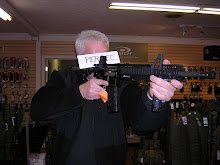

 Posts
Posts


